<?xml version="1.0" encoding="utf-8"?><feed xmlns="http://www.w3.org/2005/Atom" ><generator uri="https://jekyllrb.com/" version="3.10.0">Jekyll</generator><link href="https://wastepaper.website/feed.xml" rel="self" type="application/atom+xml" /><link href="https://wastepaper.website/" rel="alternate" type="text/html" /><updated>2026-10-02T14:10:28+00:00</updated><id>https://wastepaper.website/feed.xml</id><title type="html">Wastepaper</title><entry><title type="html">Augenblick</title><link href="https://wastepaper.website/2018/01/03/augenblick/" rel="alternate" type="text/html" title="Augenblick" /><published>2018-01-03T00:00:00+00:00</published><updated>2018-01-03T00:00:00+00:00</updated><id>https://wastepaper.website/2018/01/03/augenblick</id><content type="html" xml:base="https://wastepaper.website/2018/01/03/augenblick/"><![CDATA[<p><img src="/images/fukase-wanibe.jpg" alt="fukase-wanibe.jpg" /><br />
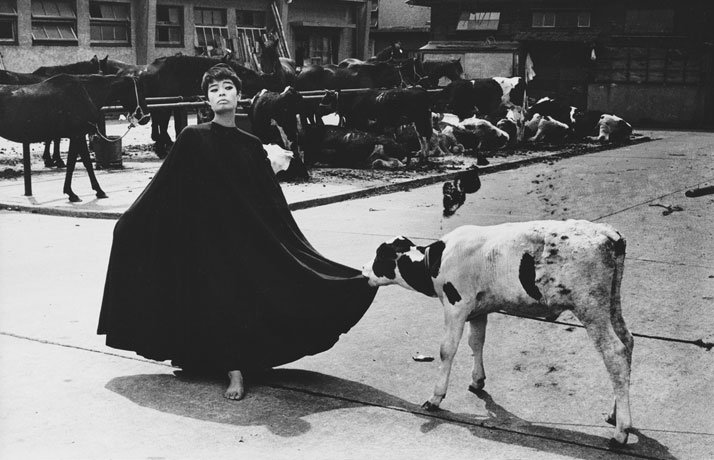
<em>Yoko Wanibe, photographed by Masahisa Fukase in a slaughterhouse near Tokyo Port</em></p>

<p>“You can’t say you’re a photographer because you take photographs. You can’t say you’re alive just because you live.” Masahisa Fukase produced some extremely despondent photography, morose and shadowy even when the subject matter seems playful, and a statement like this one (found in his papers after his death) really only formalises an idea expressed much more forcefully by his images. Are you alive? Are you really producing art, or has art production become routine? Are you looking without seeing?</p>

<p>It’s easy to take absent-minded photographs. A camera makes mimesis mechanical and automatic. The human operator has to struggle against the technical apparatus to restore a volitional element to the photographic image. This tension between camera and photographer is related to a larger dilemma. Life is full of different determinisms — economic, technological, genetic — and even when we think we’ve escaped them they keep reasserting themselves unexpectedly. Today there are scientists who believe that the mastery of nature is science’s principal end, yet many of these same scientists like to claim that evolutionary logic is an inescapable reality to which we all must submit. Like their counterparts in the economics faculty, they think they know how to distinguish between the things we can change and the things we can only observe. But the impoverished pragmatism of Niebuhr’s ‘Serenity Prayer’ (beloved by North Americans) becomes a con when ‘the wisdom to know the difference’ is foisted on us from above, enshrined in law, exempted from criticism. When we resign ourselves to the ‘things we cannot change’ we transform a political decision into a disinterested observation. The subtlety of dialectical thinking gives way to the self-destructive realism of the <a href="https://en.wikipedia.org/wiki/OODA_loop">OODA loop</a>. Self-preservation isn’t life; empirical observation isn’t sight; and the relationship between the two activities — looking and living — will vary depending on the relative hopelessness of our situation.</p>

<p><img src="/images/fukase-cats.jpg" alt="fukase-cats.jpg" /></p>

<blockquote>
  <p>Never before has censorship been so perfect. Never before have those who are still led to believe, in a few countries, that they remain free citizens, been less entitled to make their opinions heard, wherever it is a matter of choices affecting their real lives. Never before has it been possible to lie to them so brazenly. The spectator is simply supposed to know nothing, and deserve nothing. Those who are always watching to see what happens next will never act: such must be the spectator’s condition.<br />
—Guy Debord, <em>Comments on the Society of the Spectacle</em></p>
</blockquote>

<p>Aesthetic pleasures are always closely connected to the deliberateness of art and spectatorship. This is true even for the contingent parts of an artwork (a detail may be unintended, but it is always a side-effect of the original design). Very few aesthetic experiences escape this rule. An atheist looking at a sunset imagines he is impressed by dispassionate, huge, non-volitional physical processes, but on a more fundamental level he enjoys his own apprehension of the scene. There’s always a bit of mastery, control, and discernment involved in the act of looking. But the ultramodern world is now succumbing to tendencies that are a hundred times removed from anything like an interpretable ‘intention’. The iron laws of mechanised economic growth have very nearly developed to the point where they are no longer subject to the control of human institutions; the changes in the earth’s atmosphere, oceans, and ecosystems may have already turned exponential and irreversible. Not only have these tendencies escaped human control, they are also increasingly resistant to contemplation, even at an extremely abstract level. Their effects will eventually destroy art’s conditions of possibility. In the meantime they cannot even be ‘looked at’.</p>

<p><img src="/images/fukase-bath.jpg" alt="fukase-bath.jpg" /></p>

<p><em>Anagnorisis</em>: There are many of us, but we’re not always easy to spot. We live like we’re anticipating something. Depression is a condition that overtakes you after a disturbing realisation. The particular content of this realisation doesn’t matter. It only has to make your bad circumstances seem endless. You begin to fixate on the unlikelihood of real, positive change. Weirdly enough, the conviction that things are permanently broken causes you to live with one eye on the future. You keep yourself in reserve; your metabolism slows down; you wait for an impossible upheaval, world revolution. You are obsessed with your terrible prospects, and this makes it hard to enjoy anything, but at the same time, in another part of your brain, your refusal to accept this intolerable situation turns into a principled resistance to the normal patterns of life. Anhedonic waiting is a way of bearing witness to how bad things really are.</p>

<p><img src="/images/fukase-gallery.jpg" alt="fukase-gallery.jpg" /></p>

<p>Depressed people wait for something that can only materialise if they stop waiting; depression is hope travestied. If the world’s depressed people could only make their unworldly disinterest more complete and uncompromising — if they could force themselves to stop waiting and watching — then they would act, happily, in unison, and in a truly deliberate way. They wouldn’t do it for the sake of art, or to preserve a life approximating the alienated form of an artwork. They would act in pursuit of a lived life, a generous immediacy, hoping to discover new forms of excitement and boredom that don’t relentlessly cancel one another; that don’t sting. Every temporal debt would be written off.</p>

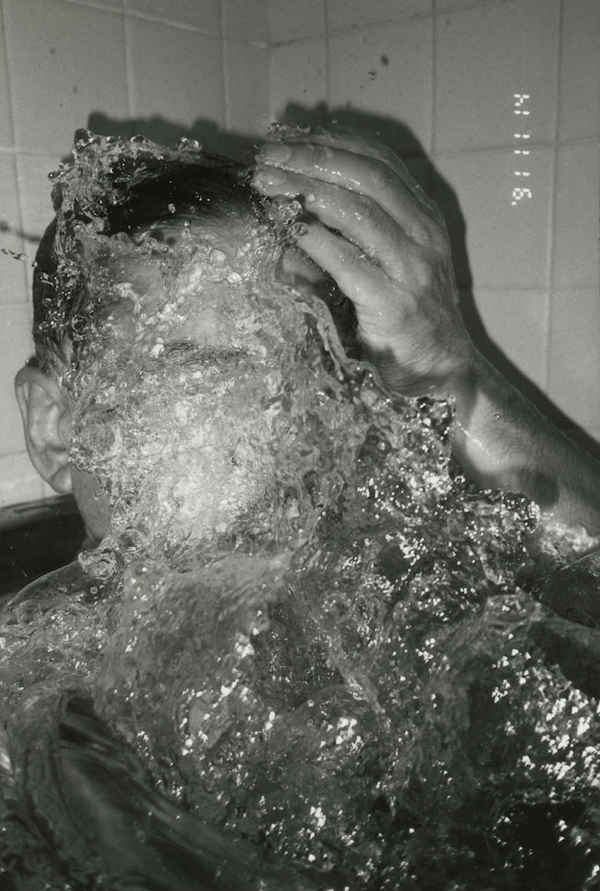
<p>Looking at Fukase’s pictures of his wife, his cats, and (much later) his depressed wallowing in the bath, one starts to suspect that most of us never experience the present. Only the camera captures it — the rest of us are too slow.</p>]]></content><author><name></name></author><summary type="html"><![CDATA[Yoko Wanibe, photographed by Masahisa Fukase in a slaughterhouse near Tokyo Port “You can’t say you’re a photographer because you take photographs. You can’t say you’re alive just because you live.” Masahisa Fukase produced some extremely despondent photography, morose and shadowy even when the subject matter seems playful, and a statement like this one (found in his papers after his death) really only formalises an idea expressed much more forcefully by his images. Are you alive? Are you really producing art, or has art production become routine? Are you looking without seeing? It’s easy to take absent-minded photographs. A camera makes mimesis mechanical and automatic. The human operator has to struggle against the technical apparatus to restore a volitional element to the photographic image. This tension between camera and photographer is related to a larger dilemma. Life is full of different determinisms — economic, technological, genetic — and even when we think we’ve escaped them they keep reasserting themselves unexpectedly. Today there are scientists who believe that the mastery of nature is science’s principal end, yet many of these same scientists like to claim that evolutionary logic is an inescapable reality to which we all must submit. Like their counterparts in the economics faculty, they think they know how to distinguish between the things we can change and the things we can only observe. But the impoverished pragmatism of Niebuhr’s ‘Serenity Prayer’ (beloved by North Americans) becomes a con when ‘the wisdom to know the difference’ is foisted on us from above, enshrined in law, exempted from criticism. When we resign ourselves to the ‘things we cannot change’ we transform a political decision into a disinterested observation. The subtlety of dialectical thinking gives way to the self-destructive realism of the OODA loop. Self-preservation isn’t life; empirical observation isn’t sight; and the relationship between the two activities — looking and living — will vary depending on the relative hopelessness of our situation. Never before has censorship been so perfect. Never before have those who are still led to believe, in a few countries, that they remain free citizens, been less entitled to make their opinions heard, wherever it is a matter of choices affecting their real lives. Never before has it been possible to lie to them so brazenly. The spectator is simply supposed to know nothing, and deserve nothing. Those who are always watching to see what happens next will never act: such must be the spectator’s condition. —Guy Debord, Comments on the Society of the Spectacle Aesthetic pleasures are always closely connected to the deliberateness of art and spectatorship. This is true even for the contingent parts of an artwork (a detail may be unintended, but it is always a side-effect of the original design). Very few aesthetic experiences escape this rule. An atheist looking at a sunset imagines he is impressed by dispassionate, huge, non-volitional physical processes, but on a more fundamental level he enjoys his own apprehension of the scene. There’s always a bit of mastery, control, and discernment involved in the act of looking. But the ultramodern world is now succumbing to tendencies that are a hundred times removed from anything like an interpretable ‘intention’. The iron laws of mechanised economic growth have very nearly developed to the point where they are no longer subject to the control of human institutions; the changes in the earth’s atmosphere, oceans, and ecosystems may have already turned exponential and irreversible. Not only have these tendencies escaped human control, they are also increasingly resistant to contemplation, even at an extremely abstract level. Their effects will eventually destroy art’s conditions of possibility. In the meantime they cannot even be ‘looked at’. Anagnorisis: There are many of us, but we’re not always easy to spot. We live like we’re anticipating something. Depression is a condition that overtakes you after a disturbing realisation. The particular content of this realisation doesn’t matter. It only has to make your bad circumstances seem endless. You begin to fixate on the unlikelihood of real, positive change. Weirdly enough, the conviction that things are permanently broken causes you to live with one eye on the future. You keep yourself in reserve; your metabolism slows down; you wait for an impossible upheaval, world revolution. You are obsessed with your terrible prospects, and this makes it hard to enjoy anything, but at the same time, in another part of your brain, your refusal to accept this intolerable situation turns into a principled resistance to the normal patterns of life. Anhedonic waiting is a way of bearing witness to how bad things really are. Depressed people wait for something that can only materialise if they stop waiting; depression is hope travestied. If the world’s depressed people could only make their unworldly disinterest more complete and uncompromising — if they could force themselves to stop waiting and watching — then they would act, happily, in unison, and in a truly deliberate way. They wouldn’t do it for the sake of art, or to preserve a life approximating the alienated form of an artwork. They would act in pursuit of a lived life, a generous immediacy, hoping to discover new forms of excitement and boredom that don’t relentlessly cancel one another; that don’t sting. Every temporal debt would be written off. Looking at Fukase’s pictures of his wife, his cats, and (much later) his depressed wallowing in the bath, one starts to suspect that most of us never experience the present. Only the camera captures it — the rest of us are too slow.]]></summary></entry><entry><title type="html">Piecework</title><link href="https://wastepaper.website/2018/01/02/piecework/" rel="alternate" type="text/html" title="Piecework" /><published>2018-01-02T00:00:00+00:00</published><updated>2018-01-02T00:00:00+00:00</updated><id>https://wastepaper.website/2018/01/02/piecework</id><content type="html" xml:base="https://wastepaper.website/2018/01/02/piecework/"><![CDATA[<blockquote>
  <p>People want Ulrich to <em>do</em> something. But I’m concerned with the <em>meaning</em> of the action. Today these are confused with each other. Of course Bolshevism, for example, has to occur; but (a) not through books, (b) books have other tasks.<br />
—Robert Musil, notes for a preface to <em>The Man Without Qualities</em></p>
</blockquote>

<blockquote>
  <p>We do not want our subjugation to market demands to be presented as free journalism, or the art of meeting deadlines to be confused with the art of presenting people with the truth. We do not want editorial democracy to grind like sand in the gears, and we want the columnists’ freedom to be recognised for what it is: a prestige and profit factor, a fraud for the readers, self-deception, a personality cult. You have to be a columnist to be allowed to describe the freedom of the columnist as the other side of the editor’s lack of freedom. To prevent theory from turning into practice, we pay for the luxury of columnists: powerless individuals, outsiders, stars.<br />
—Ulrike Meinhof, ‘Columnism’</p>
</blockquote>

<blockquote>
  <p>Every time Ulrich spoke this way, reasoning politely, Schmeisser could not contain himself and exploded anew. “Everything you’re saying springs from the moral corruption of bourgeois society!” he would then proclaim, or something similar, for there was nothing he hated more than that form of goodness opposed to reason which is found in amiability; indeed, all form, even that of beauty, was for him an object of suspicion. For this reason he never accepted even one of Ulrich’s invitations, but at most let himself be treated to tea and cigarettes, as if in Russian novels. Ulrich loved to provoke him, although these conversations were completely meaningless. Since the year of liberation in ‘48 and the founding of the German Empire, events that only a minority now personally remembered, politics probably seemed to the majority of educated people more an atavism than an important subject. There was next to no sign that behind these external processes that plodded along out of habit, intellectual processes were already preparing for that deformation, for that propensity for decline, and for the suicidal willingness arising from self-loathing, which undermine a state of affairs and apparently always form the passive precondition to periods of violent political change. Thus his whole life long Ulrich, too, had been accustomed to expect that politics would bring about not what needed to happen but at best what ought to have happened long since. The image it presented to him was mostly that of criminal neglect. The social question too, which formed the whole of Schmeisser’s universe, appeared to him not as a question but merely as an omitted answer, though he could list a hundred other such “questions” on which the mental files had been closed and which, as one might say, were waiting in vain for manipulative treatment in the Office of Dispatch.<br />
—Musil, <em>The Man Without Qualities</em></p>
</blockquote>

<blockquote>
  <p>There is surely no need here to say much about the catalogue of decline which is the daily fare of the news media in every Western country. The advanced capitalist economies have been in a deep and prolonged recession, while the collapse of Communism has exposed the fissures and contradictions within the capitalist world which had been papered over and disguised by the Cold War. The stronger European economies are experiencing what for them are new forms of long-term structural unemployment, and the unification of Germany has dramatically aggravated the weaknesses that were already beginning to appear before in Europe’s most successful economy. Japan has begun to suffer the ills to which its economic ‘miracle’ has long seemed immune (never mind the burdensome conditions of life and work that have always sustained it). Meanwhile, we are assured that in the US and elsewhere the recalcitrant recession has at last been reversed; but economists have been even more than usually selective in their reading of economic ‘indicators’ in order to demonstrate a ‘turn-around’ in the economy while setting aside the evidence that mass unemployment or underemployment, poverty, homelessness, racism and violent crime seem to be permanent fixtures in the world’s richest countries. The somewhat lower rates of unemployment in the US have been achieved at the cost of growth in low-wage jobs and a large class of working poor. Nor has the Western world’s growing ecological consciousness been able to make any significant inroads in capitalism’s structural imperative to degrade the environment.<br />
—Ellen Meiksins Wood, <em>Democracy Against Capitalism</em></p>
</blockquote>

<blockquote>
  <p>…one of the major weaknesses of American thought, resulting from its history and its ideology, is that it has no long-term vision. This thought is embedded in the <em>immediate</em>, about which it collects an alarmingly large quantity of data.<br />
—Samir Amin, <em>The Liberal Virus</em></p>
</blockquote>

<blockquote>
  <p>If a man be in any vague latent doubt about the intrinsic correctness and excellence of his general life-theory and practical course of life; then, if that man chance to light on any other man, or any little treatise, or sermon, which unintendingly, as it were, yet very palpably illustrates to him the intrinsic incorrectness and non-excellence of both the theory and the practice of his life; then that man will — more or less unconsciously — try hard to hold himself back from the self-admitted comprehension of a matter which thus condemns him. For in this case, to comprehend, is himself to condemn himself, which is always highly inconvenient and uncomfortable to a man. Again. If a man be told a thing wholly new, then — during the time of its first announcement to him — it is entirely impossible for him to comprehend it. For — absurd as it may seem — men are only made to comprehend things which they comprehended before (though but in the embryo, as it were). Things new it is impossible to make them comprehend, by merely talking to them about it. True, sometimes they pretend to comprehend; in their own hearts they really believe they do comprehend; outwardly look as though they did comprehend; wag their bushy tails comprehendingly; but for all that, they do not comprehend. Possibly, they may afterward come, of themselves, to inhale this new idea from the circumambient air, and so come to comprehend it; but not otherwise at all.<br />
—Melville, <em>Pierre,  or The Ambiguities</em></p>
</blockquote>

<blockquote>
  <p>For the circle, the ring of people, the school, or the widespread success that emanates from anyone involved in an intellectual activity is negligible compared to the plenitude of sects whose souls are nourished on eating cherries, on the theater of the great outdoors, on musical gymnastics, on Eubiotics, or any one of a thousand other oddities. It is impossible to say how many such Romes there are, each of which has its own Pope, whose name the uninitiated have never heard, whose followers, however, look to him for the salvation of mankind. All of Germany is teeming with such spiritual brotherhoods: and from this great Germany, in which famous scientists can live only by their teaching and select poets at best by marketing journalistic bagatelles, from this same Germany, innumerable lunatics are swarmed with the means and participants for the development of their whims, for the printing of their books and for the founding of their periodicals. For that reason, before bad times recently set in in Germany, more than a thousand magazines were founded annually and more than thirty thousand books appeared, and this was deemed the sign of a towering intellectual achievement.<br />
It is unfortunately to be assumed with infinitely greater certainty that this will rather turn out to have been a sign, not recognized early enough, of the spread of a dangerous group-mania. Infected by this mania, thousands of little groups peddle their own set notion of life, so that it ought not to surprise us if soon a genuine paranoiac will hardly still be able to resist competing with the amateurs.<br />
—Musil, ‘Surrounded by Poets and Thinkers’</p>
</blockquote>

<blockquote>
  <p>In these great times which I knew when they were this small; which will become small again, provided they have time left for it; and which, because in the realm of organic growth no such transformation is possible, we had better call fat times and, truly, hard times as well; in these times in which things are happening that could not be imagined and in which what can no longer be imagined must happen, for if one could imagine it, it would not happen; in these serious times which have died laughing at the thought that they might become serious; which, surprised by their own tragedy, are reaching for diversion and, catching themselves red-handed, are groping for words; in these loud times which boom with the horrible symphony of actions which produce reports and of reports which cause actions; in these times you should not expect any words of my own from me — none but these words which barely manage to prevent silence from being misinterpreted.<br />
—Karl Kraus</p>
</blockquote>]]></content><author><name></name></author><summary type="html"><![CDATA[People want Ulrich to do something. But I’m concerned with the meaning of the action. Today these are confused with each other. Of course Bolshevism, for example, has to occur; but (a) not through books, (b) books have other tasks. —Robert Musil, notes for a preface to The Man Without Qualities We do not want our subjugation to market demands to be presented as free journalism, or the art of meeting deadlines to be confused with the art of presenting people with the truth. We do not want editorial democracy to grind like sand in the gears, and we want the columnists’ freedom to be recognised for what it is: a prestige and profit factor, a fraud for the readers, self-deception, a personality cult. You have to be a columnist to be allowed to describe the freedom of the columnist as the other side of the editor’s lack of freedom. To prevent theory from turning into practice, we pay for the luxury of columnists: powerless individuals, outsiders, stars. —Ulrike Meinhof, ‘Columnism’ Every time Ulrich spoke this way, reasoning politely, Schmeisser could not contain himself and exploded anew. “Everything you’re saying springs from the moral corruption of bourgeois society!” he would then proclaim, or something similar, for there was nothing he hated more than that form of goodness opposed to reason which is found in amiability; indeed, all form, even that of beauty, was for him an object of suspicion. For this reason he never accepted even one of Ulrich’s invitations, but at most let himself be treated to tea and cigarettes, as if in Russian novels. Ulrich loved to provoke him, although these conversations were completely meaningless. Since the year of liberation in ‘48 and the founding of the German Empire, events that only a minority now personally remembered, politics probably seemed to the majority of educated people more an atavism than an important subject. There was next to no sign that behind these external processes that plodded along out of habit, intellectual processes were already preparing for that deformation, for that propensity for decline, and for the suicidal willingness arising from self-loathing, which undermine a state of affairs and apparently always form the passive precondition to periods of violent political change. Thus his whole life long Ulrich, too, had been accustomed to expect that politics would bring about not what needed to happen but at best what ought to have happened long since. The image it presented to him was mostly that of criminal neglect. The social question too, which formed the whole of Schmeisser’s universe, appeared to him not as a question but merely as an omitted answer, though he could list a hundred other such “questions” on which the mental files had been closed and which, as one might say, were waiting in vain for manipulative treatment in the Office of Dispatch. —Musil, The Man Without Qualities There is surely no need here to say much about the catalogue of decline which is the daily fare of the news media in every Western country. The advanced capitalist economies have been in a deep and prolonged recession, while the collapse of Communism has exposed the fissures and contradictions within the capitalist world which had been papered over and disguised by the Cold War. The stronger European economies are experiencing what for them are new forms of long-term structural unemployment, and the unification of Germany has dramatically aggravated the weaknesses that were already beginning to appear before in Europe’s most successful economy. Japan has begun to suffer the ills to which its economic ‘miracle’ has long seemed immune (never mind the burdensome conditions of life and work that have always sustained it). Meanwhile, we are assured that in the US and elsewhere the recalcitrant recession has at last been reversed; but economists have been even more than usually selective in their reading of economic ‘indicators’ in order to demonstrate a ‘turn-around’ in the economy while setting aside the evidence that mass unemployment or underemployment, poverty, homelessness, racism and violent crime seem to be permanent fixtures in the world’s richest countries. The somewhat lower rates of unemployment in the US have been achieved at the cost of growth in low-wage jobs and a large class of working poor. Nor has the Western world’s growing ecological consciousness been able to make any significant inroads in capitalism’s structural imperative to degrade the environment. —Ellen Meiksins Wood, Democracy Against Capitalism …one of the major weaknesses of American thought, resulting from its history and its ideology, is that it has no long-term vision. This thought is embedded in the immediate, about which it collects an alarmingly large quantity of data. —Samir Amin, The Liberal Virus If a man be in any vague latent doubt about the intrinsic correctness and excellence of his general life-theory and practical course of life; then, if that man chance to light on any other man, or any little treatise, or sermon, which unintendingly, as it were, yet very palpably illustrates to him the intrinsic incorrectness and non-excellence of both the theory and the practice of his life; then that man will — more or less unconsciously — try hard to hold himself back from the self-admitted comprehension of a matter which thus condemns him. For in this case, to comprehend, is himself to condemn himself, which is always highly inconvenient and uncomfortable to a man. Again. If a man be told a thing wholly new, then — during the time of its first announcement to him — it is entirely impossible for him to comprehend it. For — absurd as it may seem — men are only made to comprehend things which they comprehended before (though but in the embryo, as it were). Things new it is impossible to make them comprehend, by merely talking to them about it. True, sometimes they pretend to comprehend; in their own hearts they really believe they do comprehend; outwardly look as though they did comprehend; wag their bushy tails comprehendingly; but for all that, they do not comprehend. Possibly, they may afterward come, of themselves, to inhale this new idea from the circumambient air, and so come to comprehend it; but not otherwise at all. —Melville, Pierre, or The Ambiguities For the circle, the ring of people, the school, or the widespread success that emanates from anyone involved in an intellectual activity is negligible compared to the plenitude of sects whose souls are nourished on eating cherries, on the theater of the great outdoors, on musical gymnastics, on Eubiotics, or any one of a thousand other oddities. It is impossible to say how many such Romes there are, each of which has its own Pope, whose name the uninitiated have never heard, whose followers, however, look to him for the salvation of mankind. All of Germany is teeming with such spiritual brotherhoods: and from this great Germany, in which famous scientists can live only by their teaching and select poets at best by marketing journalistic bagatelles, from this same Germany, innumerable lunatics are swarmed with the means and participants for the development of their whims, for the printing of their books and for the founding of their periodicals. For that reason, before bad times recently set in in Germany, more than a thousand magazines were founded annually and more than thirty thousand books appeared, and this was deemed the sign of a towering intellectual achievement. It is unfortunately to be assumed with infinitely greater certainty that this will rather turn out to have been a sign, not recognized early enough, of the spread of a dangerous group-mania. Infected by this mania, thousands of little groups peddle their own set notion of life, so that it ought not to surprise us if soon a genuine paranoiac will hardly still be able to resist competing with the amateurs. —Musil, ‘Surrounded by Poets and Thinkers’ In these great times which I knew when they were this small; which will become small again, provided they have time left for it; and which, because in the realm of organic growth no such transformation is possible, we had better call fat times and, truly, hard times as well; in these times in which things are happening that could not be imagined and in which what can no longer be imagined must happen, for if one could imagine it, it would not happen; in these serious times which have died laughing at the thought that they might become serious; which, surprised by their own tragedy, are reaching for diversion and, catching themselves red-handed, are groping for words; in these loud times which boom with the horrible symphony of actions which produce reports and of reports which cause actions; in these times you should not expect any words of my own from me — none but these words which barely manage to prevent silence from being misinterpreted. —Karl Kraus]]></summary></entry><entry><title type="html">Hypertext</title><link href="https://wastepaper.website/2018/01/01/hypertext/" rel="alternate" type="text/html" title="Hypertext" /><published>2018-01-01T00:00:00+00:00</published><updated>2018-01-01T00:00:00+00:00</updated><id>https://wastepaper.website/2018/01/01/hypertext</id><content type="html" xml:base="https://wastepaper.website/2018/01/01/hypertext/"><![CDATA[<p>All writing is occasional writing, but recently the occasional side of things has got out of hand. This is a complaint you will have heard before, but it bears repeating, if only because the sliver of time called the present seems to shrink week by week. It is as if every short article that wants to be read by more than a dozen people must now identify, preferably in its first line, the media event which occasioned it. Each sentence must have some bearing on something that happened no more than ten days ago. Never mind that these appeals to the present often read like sublimated expressions of the writer’s anxiety (a fear of irrelevance, poverty, forgetfulness, loneliness) — the truly successful essay manages to transform all this fear into good-humoured verbal energy. Today everyone writes frenziedly.</p>

<p>The formal features of hypertext have something to do with this. Everyone knows that the ranking of a web page in a given set of search results is partly determined by the number of links pointing to that page. (Links originating on other commonly linked-to sites confer a higher score.) The apportioning of visibility on the big social media sites is the result of an identical process: the network’s users are all connected to one another, more popular users are connected to a greater number of less popular users, and an article will succeed or fail depending on which nodes in the network are willing to link to it. Early theorists and designers of the internet (like Alan Kay) always claimed that liberty was encoded in its non-hierarchical structure — the web has no centre, it consists of end-to-end, peer-to-peer connections — and it is true that the organic allocation of attention by the network does sometimes allow for insurgencies. Things linked to by a big node are granted a high degree of visibility, but the same level of visibility would result from a larger number of links from smaller nodes. There’s always a chance that the marginal can become momentarily central, provided the ‘marketplace of ideas’ remains as frictionless as its designers intended. The problem with this arrangement is that anything asocial becomes completely invisible. The world constructed from electronic communications is one in which attention gives substance to everything. Things unwitnessed make no sound, leave no trace, lack solidity. The situation is different in the world of paper and ink. Not all printed books find an audience, but as long as they aren’t pulped they have a very long afterlife. The internet isn’t as ephemeral as we tend to imagine — it has a material substratum, and things posted here don’t vanish as readily as we’d like to believe — but unlike print culture the web is capable of swift and total erasure. It metes out oblivion effortlessly. Is your writing really signal, or is it just noise? It might look like noise to certain housekeeping algorithms. Writing which circulates on the internet must have the character of legal tender if it hopes to survive and be read: it must be valuable or intelligible to other people, it must be current, it must owe its legibility to an existing network of words and images. Otherwise it disappears.</p>

<p>Fearful of becoming invisible and isolated, more and more writing starts to take on the characteristics of journalism. In the same way that government-issued reports and sociological studies are the formal opposites of the realist novel, the articles and essays that circulate today are the negative form of the last century’s communiqués and manifestos. The manifesto was a group statement which complemented an action or event that the group itself had a hand in — an exhibition, an act of terrorism — whereas today’s saleable essay represents the individual voice of one who wishes to comment on things beyond the individual’s control: a war, a scientific discovery, a TV series. Stylistically, however, the essayist may sometimes use the peremptory tone of the communiqué, the same way Stendhal imitated the precise objective language of the Code Napoleon. An element of outspoken individuality helps to disguise the drudge work of annotating the present. Without this individual element the essayist risks being forgotten by the readers.</p>

<p>It’s strange to see people your own age become columnists. It’s particularly strange now, in the UK, because among the current crop of young writers there are several who owe their position to the events of 2008 and 2010, i.e. the crash and the protests, glimpses of anti-systemic turmoil which informed their politics and the politics of many of their contemporaries. All these writers had to do was say what they saw and they would be speaking for many of us. Yet to become a columnist something else is required: the columnist must link their political perspective to their personality. The moment this happens everything starts to become frozen again: the wave recedes, an old pattern reasserts itself, advances are handed out, people reconcile themselves to the things they are contractually obliged to criticise. There’s probably nothing to be done about it.</p>

<p>You sometimes remember (sat in front of your desk, staring at your computer, vegetating) that there is no shortage of brilliant young writers. They are everywhere. The roar of keystrokes sounds like a blast furnace.</p>]]></content><author><name></name></author><summary type="html"><![CDATA[All writing is occasional writing, but recently the occasional side of things has got out of hand. This is a complaint you will have heard before, but it bears repeating, if only because the sliver of time called the present seems to shrink week by week. It is as if every short article that wants to be read by more than a dozen people must now identify, preferably in its first line, the media event which occasioned it. Each sentence must have some bearing on something that happened no more than ten days ago. Never mind that these appeals to the present often read like sublimated expressions of the writer’s anxiety (a fear of irrelevance, poverty, forgetfulness, loneliness) — the truly successful essay manages to transform all this fear into good-humoured verbal energy. Today everyone writes frenziedly. The formal features of hypertext have something to do with this. Everyone knows that the ranking of a web page in a given set of search results is partly determined by the number of links pointing to that page. (Links originating on other commonly linked-to sites confer a higher score.) The apportioning of visibility on the big social media sites is the result of an identical process: the network’s users are all connected to one another, more popular users are connected to a greater number of less popular users, and an article will succeed or fail depending on which nodes in the network are willing to link to it. Early theorists and designers of the internet (like Alan Kay) always claimed that liberty was encoded in its non-hierarchical structure — the web has no centre, it consists of end-to-end, peer-to-peer connections — and it is true that the organic allocation of attention by the network does sometimes allow for insurgencies. Things linked to by a big node are granted a high degree of visibility, but the same level of visibility would result from a larger number of links from smaller nodes. There’s always a chance that the marginal can become momentarily central, provided the ‘marketplace of ideas’ remains as frictionless as its designers intended. The problem with this arrangement is that anything asocial becomes completely invisible. The world constructed from electronic communications is one in which attention gives substance to everything. Things unwitnessed make no sound, leave no trace, lack solidity. The situation is different in the world of paper and ink. Not all printed books find an audience, but as long as they aren’t pulped they have a very long afterlife. The internet isn’t as ephemeral as we tend to imagine — it has a material substratum, and things posted here don’t vanish as readily as we’d like to believe — but unlike print culture the web is capable of swift and total erasure. It metes out oblivion effortlessly. Is your writing really signal, or is it just noise? It might look like noise to certain housekeeping algorithms. Writing which circulates on the internet must have the character of legal tender if it hopes to survive and be read: it must be valuable or intelligible to other people, it must be current, it must owe its legibility to an existing network of words and images. Otherwise it disappears. Fearful of becoming invisible and isolated, more and more writing starts to take on the characteristics of journalism. In the same way that government-issued reports and sociological studies are the formal opposites of the realist novel, the articles and essays that circulate today are the negative form of the last century’s communiqués and manifestos. The manifesto was a group statement which complemented an action or event that the group itself had a hand in — an exhibition, an act of terrorism — whereas today’s saleable essay represents the individual voice of one who wishes to comment on things beyond the individual’s control: a war, a scientific discovery, a TV series. Stylistically, however, the essayist may sometimes use the peremptory tone of the communiqué, the same way Stendhal imitated the precise objective language of the Code Napoleon. An element of outspoken individuality helps to disguise the drudge work of annotating the present. Without this individual element the essayist risks being forgotten by the readers. It’s strange to see people your own age become columnists. It’s particularly strange now, in the UK, because among the current crop of young writers there are several who owe their position to the events of 2008 and 2010, i.e. the crash and the protests, glimpses of anti-systemic turmoil which informed their politics and the politics of many of their contemporaries. All these writers had to do was say what they saw and they would be speaking for many of us. Yet to become a columnist something else is required: the columnist must link their political perspective to their personality. The moment this happens everything starts to become frozen again: the wave recedes, an old pattern reasserts itself, advances are handed out, people reconcile themselves to the things they are contractually obliged to criticise. There’s probably nothing to be done about it. You sometimes remember (sat in front of your desk, staring at your computer, vegetating) that there is no shortage of brilliant young writers. They are everywhere. The roar of keystrokes sounds like a blast furnace.]]></summary></entry><entry><title type="html">Charles Reznikoff’s Objective Aesthetics</title><link href="https://wastepaper.website/2017/12/03/reznikoff/" rel="alternate" type="text/html" title="Charles Reznikoff’s Objective Aesthetics" /><published>2017-12-03T00:00:00+00:00</published><updated>2017-12-03T00:00:00+00:00</updated><id>https://wastepaper.website/2017/12/03/reznikoff</id><content type="html" xml:base="https://wastepaper.website/2017/12/03/reznikoff/"><![CDATA[<p><img src="/images/reznikoff-window.jpg" alt="reznikoff-window.jpg" /></p>

<p><strong>Representing History</strong></p>

<p>Charles Reznikoff’s <em>Testimony</em> is an unusual literary work. Like the ‘conceptual’ or ‘uncreative’ writing lately practised by poets such as Vanessa Place and Kenneth Goldsmith, it consists entirely of language taken from other sources — the law reports that Reznikoff read while he was working for the legal encyclopaedia <em>Corpus Juris</em>.<sup id="fnref:1" role="doc-noteref"><a href="#fn:1" class="footnote" rel="footnote">1</a></sup> The first edition of <em>Testimony</em> appeared in 1934, but Reznikoff returned to the project in the 1960s and ‘70s and expanded it considerably: the second version of <em>Testimony</em>, eventually published in two volumes in 1978, contains more than four hundred cases and bears the subtitle <em>United States (1885–1915): Recitative</em>, thereby situating itself somewhere between chronicle and libretto. The 1934 version covers a slightly earlier period of history and is much shorter; it is also written in prose, whereas the later version makes use of line breaks, transforming the source material into blocks of austere free verse.</p>

<p>Reznikoff’s job at <em>Corpus Juris</em> was to look through old volumes of the West Publishing Company’s <em>National Reporter System</em>, a nearly exhaustive record of all the cases brought before federal and appellate state courts since 1789, and then to write short, compressed accounts of rulings with precedential value. The numbered sections of <em>Testimony</em> are the negative image of the entries in <em>Corpus Juris</em>: Reznikoff never includes the details of any judgement — the mechanisms of the court are almost completely absent from the pages of <em>Testimony</em> — and all the sordid, bloody details omitted from the legal encyclopaedia instead become the focus of his text. The following ‘case’, from the section titled ‘Southerners and Slaves’, is fairly typical of the work as a whole:</p>

<blockquote>
  <p>John Wilson and his younger brother, Cumberland, were cutting timber on a ridge in the woods when Ballentine came up. He had a rifle and a squirrel which he had shot, said that it was hot weather for cutting sticks, and left, going over the ridge. Later, he came out of the woods, and stood watching them.</p>

  <p>John Wilson, sitting on the top log, turned his face to the team. The front pair of oxen had started, but the others were still standing. Cumberland Wilson was just rising to tell Ballentine good-by, when he saw him with his rifle up, the breach of it under his shoulder and the muzzle aimed at John. That instant Ballentine fired and Cumberland saw the smoke rising from Ballentine’s gun. John Wilson put his right hand to his breast and said, “Lord of Mercy!” The blood gushed from his mouth and nose. Ballentine began to run away; he ran ten steps or so, stopped, and looked John Wilson in the face. The dying man bowed his head and Ballentine ran on.<sup id="fnref:2" role="doc-noteref"><a href="#fn:2" class="footnote" rel="footnote">2</a></sup></p>
</blockquote>

<p>As in many of the other sections of <em>Testimony</em>, Reznikoff strips away just enough of the original case history to make the crime’s context and motivation only dimly perceptible. The events directly preceding and following the scene are omitted, and the lack of context produces a kind of estrangement effect (comparable to, but by no means the same as, the <em>Verfremdungseffekt</em> theorised by Brecht), drawing out certain unusual, evocative, or disturbing details that would have been lost in the translation of the case into a precedent in a textbook. For example: the way Ballentine begins to run but then stops to look directly at John Wilson; the fact that Cumberland sees ‘the smoke rising from Ballentine’s gun’ before he sees that John has been shot; the topography of the ‘ridge in the woods’ where the Wilsons make their living (the forests of the southern US are one of the country’s main sources of timber). The parts of <em>Testimony</em> that command the most interest are always these details, the ‘historic and contemporary particulars’ (to borrow Louis Zukofsky’s phrase), contingent facts which often represent larger social structures in microcosm.<sup id="fnref:3" role="doc-noteref"><a href="#fn:3" class="footnote" rel="footnote">3</a></sup></p>

<p><strong>Reading Reznikoff’s Intentions</strong></p>

<p>Because of its subject matter and its mode of expression, critics have tended to include <em>Testimony</em> in a canon of experimental and political literature written in the US in the inter-war period.<sup id="fnref:4" role="doc-noteref"><a href="#fn:4" class="footnote" rel="footnote">4</a></sup> Writers working in this mode often sought to associate their work with documentary photography, either by publishing it alongside photographs, as in James Agee and Walker Evans’s <em>Let Us Now Praise Famous Men</em>, or by aspiring to imitate those photographs’ <em>vérité</em> style. In an article on the political implications of Reznikoff’s documentary poetry Michael Davidson provides a long list of similar ‘hybrid works’ from the same period, including Zora Neale Hurston’s <em>Mules and Men</em>, Hart Crane’s <em>The Bridge</em>, John Dos Passos’s <em>U.S.A.</em> trilogy, and Muriel Rukeyser’s ‘Book of the Dead’.<sup id="fnref:5" role="doc-noteref"><a href="#fn:5" class="footnote" rel="footnote">5</a></sup> Davidson claims that the Depression was the ‘enabling moment’ for this type of literature; he reads <em>Testimony</em> alongside Rukeyser’s ‘Book of the Dead’ and finds that both texts participate in a ‘common documentary project’ that aims to ‘provide a voice for individuals who live at the margins of a national scene’.<sup id="fnref:6" role="doc-noteref"><a href="#fn:6" class="footnote" rel="footnote">6</a></sup> Like many other close readings of <em>Testimony</em>, Davidson’s brings out the critical intent behind the text: Reznikoff’s purpose, Davidson suggests, is to unsettle a sanitised US national history by shedding light on its inhumane underside.</p>

<p>This view of <em>Testimony</em> as a critical and instructive text is predominant in several recent commentaries on Reznikoff’s work. It is stated particularly persuasively in Monique Vescia’s book <em>Depression Glass</em>, where she compares Reznikoff to progressive contemporaries such as Lewis Hine, one of the many photographers and sociologists of the 1930s who sought to represent ‘the larger social injustices perpetrated against the poor and working class’ by using forms that enable people and situations to ‘speak for themselves’.<sup id="fnref:7" role="doc-noteref"><a href="#fn:7" class="footnote" rel="footnote">7</a></sup> Vescia’s representation of <em>Testimony</em> is easily justified by reference to the text’s recurring themes and to the notes and drafts in which Reznikoff sometimes discusses his method and intent. Katheryn Shevelow cites some of these manuscript notes to support her claim that Reznikoff’s documentary poetry is meant to ‘provide a vivid lesson in humanity’.<sup id="fnref:8" role="doc-noteref"><a href="#fn:8" class="footnote" rel="footnote">8</a></sup> She places particular emphasis on Reznikoff’s interest in the concept of ‘catharsis’ and suggests that the text produces a morally restorative effect by confronting the reader with ‘the experience of pain and brutality’.<sup id="fnref:9" role="doc-noteref"><a href="#fn:9" class="footnote" rel="footnote">9</a></sup> A similar reading of <em>Testimony</em>’s purpose was also put forward in the very first critical reading of the work, ‘The Matter of the Document’, the introductory essay included in the 1934 edition. Written by the literary theorist Kenneth Burke at the invitation of William Carlos Williams, Burke’s short essay seeks to defend Reznikoff and his experimental text by emphasising the ‘vein of sympathy that underlies his work’; it concludes with the suggestion that the ‘truth’ of <em>Testimony</em> is its ‘usefulness to living’.<sup id="fnref:10" role="doc-noteref"><a href="#fn:10" class="footnote" rel="footnote">10</a></sup></p>

<p>As persuasive as these assessments of Reznikoff’s intentions may be, they risk reducing <em>Testimony</em> to a merely didactic piece of writing. It is obvious that Reznikoff means to indict an unjust and exploitative social system (‘an economy based on various forms of slavery’, as Vescia puts it), but it is important to recognise that the text actually exceeds this intention and achieves the status of an interesting artefact in its own right.<sup id="fnref:11" role="doc-noteref"><a href="#fn:11" class="footnote" rel="footnote">11</a></sup> The poet and translator George Szirtes is one of the few commentators who have recognised the autonomous aesthetic qualities of Reznikoff’s factual poetry. In his introduction to Reznikoff’s other documentary poem, <em>Holocaust</em>, he attempts to describe the complex way in which documentary materials can be made to approach the condition of literature, emphasising the ‘musical’ formalism of Reznikoff’s syntax:</p>

<blockquote>
  <p>To read <em>Holocaust</em> is a terrible experience, but an oddly affirming one, if only because of the music. It is a kind of debt to lost music in that it hardly seems music at all. The violin does not sob, the harmonica does not sound in the hut, the voice of the cantor does not rise from the pit. Those things are gone but we are aware of their having gone. There is no soundtrack at all. It is only perfectly objective language falling as accurately as it can, working towards some ideal and convincing cadence that is hard to tell from ordinary syntax. It is the music of sheer labour.<sup id="fnref:12" role="doc-noteref"><a href="#fn:12" class="footnote" rel="footnote">12</a></sup></p>
</blockquote>

<p>Just as Szirtes suggests, Reznikoff’s method is highly contradictory. In <em>Testimony</em> he aestheticises the functioning of an inhumane and violent social system in order to represent the full scope of its completely unaesthetic, inhumane, and violent functioning. His representation of this system is strictly mimetic: his ‘perfectly objective language’ is an imitation of those nominally objective and disinterested legal structures that strip subjects of their autonomy. It is only by way of this rigorous form of mimesis — only by producing a text that views individuals from the supra-individual perspective of the court — that Reznikoff is able to make that objective system into an object of contemplation. <em>Testimony</em> does effect a certain kind of social criticism, then, but not in the simple manner of a journalistic exposé, as some critics have suggested. The form of the work allows it to criticise the formal characteristics of the law and economy of the US, and Reznikoff’s critique of these economic and legal forms in fact bears a close resemblance to Adorno’s critical theory.</p>

<p><strong>Calculating the Law</strong></p>

<p>At several points in <em>Dialectic of Enlightenment</em> Adorno and Horkheimer apply their critique of post-Enlightenment rationality to the workings of ‘bourgeois justice’.<sup id="fnref:13" role="doc-noteref"><a href="#fn:13" class="footnote" rel="footnote">13</a></sup> In the opening chapter, for example, they suggest that the reductive tendencies inherent in formal logic, positivist science, and capitalist economy are also operative in the legal system, taking a line from Francis Bacon’s treatise The Advancement of Learning as a prototypical example of this pernicious formalism:</p>

<blockquote>
  <p>The same equations govern bourgeois justice and commodity exchange. “Is not the rule, ‘<em>Si inaequalibus aequalia addas, omnia erunt inaequalia</em>,’ [If you add like to unlike you will always end up with unlike] an axiom of justice as well as of mathematics? And is there not a true coincidence between commutative and distributive justice, and arithmetical and geometrical proportion?” Bourgeois society is ruled by equivalence. It makes dissimilar things comparable by reducing them to abstract quantities. (<em>DE</em> 4)</p>
</blockquote>

<p>Adorno and Horkheimer go on to suggest that in the unfolding of Enlightenment’s immanent logic, ‘equivalence’ is made into a ‘fetish’; once again they connect this fetishisation of calculability with the ideology of justice:</p>

<blockquote>
  <p>Earlier, fetishes had been subject to the law of equivalence. Now equivalence itself becomes a fetish. The blindfold over the eyes of Justitia means not only that justice brooks no interference but that it does not originate in freedom. (<em>DE</em> 12)</p>
</blockquote>

<p>And later in the text, in the commentary on the Odyssey, they continue to reinforce this comparison by likening the law to the ‘mythical inevitability’ that seems to dominate Homer’s narrative. ‘Scylla and Charybdis have a claim on whatever comes between their teeth, just as Circe has a right to metamorphose those who are not immune, or Polyphemus a right to the bodies of his guests’; the compulsive nature of these behaviours is evidence that ‘the natural relationship between strength and powerlessness has already taken on the character of a legal relationship’:</p>

<blockquote>
  <p>Mythical inevitability is defined by the equivalence between the curse, the abominable act which expiates it, and the guilt arising from that act, which reproduces the curse. All law in history up to now bears the trace of this pattern. In myth each moment of the cycle pays off the preceding moment and thereby helps to establish the continuity of guilt as law. (<em>DE</em> 45–46)</p>
</blockquote>

<p>The argument that emerges in these passages concerns the transformation of the law into a system of blind equivalence, one that operates compulsively or automatically and in a manner similar to nature, fate, mathematics, or the economic system. Enlightenment’s process of demythologisation and rationalisation results in the disappearance of a qualitative idea of justice and its replacement by a strictly quantitative law of equivalence: ‘Justice gives way to law’ because ‘equivalence regulates punishment and reward within civilization’ (<em>DE</em> 12). As Etienne Balibar explains, this critique of the law is already implicit in Marx’s comments on ‘fetishism’ in <em>Capital</em>; Marx’s text contains the ‘bases for an analysis of the modes of subjection’ which Balibar outlines in the following way:</p>

<blockquote>
  <p>The structure common to economic and to juridical (and moral) fetishism is generalized equivalence, which abstractly and equally subjects individuals to the form of a circulation (circulation of values, circulation of obligations). It supposes a code or a measure – both materialized and idealized – before which ‘particularity’, individual need, must yield.<sup id="fnref:14" role="doc-noteref"><a href="#fn:14" class="footnote" rel="footnote">14</a></sup></p>
</blockquote>

<p>It is therefore significant that in the original German text of the passage from <em>Dialectic of Enlightenment</em> quoted above, the word translated as ‘continuity of guilt’ is a much more suggestive compound noun: <em>Schuldzusammenhang</em>.<sup id="fnref:15" role="doc-noteref"><a href="#fn:15" class="footnote" rel="footnote">15</a></sup> As Rolf Tiedemann notes, the word is used in many of Adorno’s other writings.<sup id="fnref:16" role="doc-noteref"><a href="#fn:16" class="footnote" rel="footnote">16</a></sup> It can be translated as ‘context of guilt’ or ‘web of guilt’, but can also mean ‘debt structure’ or ‘debt relationship’. (Throughout the English translation of Adorno’s critique of Husserl, for example, <em>Schuldzusammenhang</em> is rendered as ‘debit structure’; one of Adorno’s criticisms of Husserl is that his philosophy resembles a system of credit and debit.<sup id="fnref:17" role="doc-noteref"><a href="#fn:17" class="footnote" rel="footnote">17</a></sup>) Adorno and Horkheimer’s text plays on the different meanings of the words <em>Schuld</em> (fault, blame, guilt, or debt) and <em>schulden</em> (to owe); Walter Benjamin also commented on the ‘demonic ambiguity’ of the word Schuld in his fragment ‘Capitalism as Religion’.<sup id="fnref:18" role="doc-noteref"><a href="#fn:18" class="footnote" rel="footnote">18</a></sup> Their critique is therefore founded on a comparison between debt and guilt: they argue that in civilisation — particularly in the period of modernity, but also in societies where myth and religion remain influential — the law is administered in such a way that it behaves more and more like an economic system in which exchange value governs everything and use value is of only secondary importance.</p>

<p>The germ of a similar insight is present in Reznikoff’s autobiographical poem ‘Early History of a Writer’. In the sixteenth section of this poem he describes the years he spent studying law at New York University, where he</p>

<blockquote>
  <p>learned to probe beneath the facts of each case</p>

  <p>for the living principle of law</p>

  <p>and to trace it, if I could,</p>

  <p>to the solid trunk from which it sprang;</p>

  <p>confused as it all was to me at first,</p>

  <p>I soon saw the law in its elements as a beautiful order</p>

  <p>in which benefit balanced obligation</p>

  <p>and nothing was without its reason — or reasons.<sup id="fnref:19" role="doc-noteref"><a href="#fn:19" class="footnote" rel="footnote">19</a></sup></p>
</blockquote>

<p>But Reznikoff’s enthusiasm for this ‘beautiful order’ is gradually tempered by an awareness of the law’s formal limitations. Later in the poem he remembers sitting in a library, ‘memorizing sentences that seemed meaty’, but finding himself at a conceptual and physical remove from real life:</p>

<blockquote>
  <p>The noise of the street was far away—</p>

  <p>ten storeys below;</p>

  <p>far away, too, the worry and noise of my parents’ shop;</p>

  <p>before me was all that was left of eager argument and eager parties,</p>

  <p>now merely names that might just as well have been,</p>

  <p>and in the talk of the law students often were,</p>

  <p>single letters in the alphabet:</p>

  <p>all the blood—the heartache and the heartening—gone out of the words</p>

  <p>and only, as a pattern for thinking,</p>

  <p>the cool bones of the judge’s reasoning.</p>

  <p>And I felt no regret for the glittering words I had played with</p>

  <p>and only pleasure to be working with ideas—</p>

  <p>of rights and wrongs and their elements</p>

  <p>and of justice between men in their intricate affairs. (<em>NSP</em> 131)</p>
</blockquote>

<p>Reznikoff realises that the lived experiences of the ‘eager parties’ who appeal to the law are always partly lost or simplified in the process of their subjection to an increasingly objectified legal system. Indifferent to the particularity of individual legal subjects, positing them only as variables in a system of ‘benefit’ and ‘obligation’, the law threatens to transform itself into an automatic ‘pattern for thinking’. In the legal argumentation Reznikoff witnesses at NYU, the names of the people involved in each case are reduced to ‘single letters in the alphabet’ — like the parts of an algebraic equation — and the ‘blood’ of the original dispute gives way to the ‘cool bones of the judge’s reasoning’ — a metaphor that implies petrifaction and natural decay. As <em>Dialectic of Enlightenment</em> would have it, the ‘barren wisdom’ of this form of idealism</p>

<blockquote>
  <p>incessantly reinstates what always was. Whatever might be different is made the same. That is the verdict which critically sets the boundaries to possible experience. The identity of everything with everything is bought at the cost that nothing can at the same time be identical to itself. (<em>DE</em> 8)</p>
</blockquote>

<p>Any consideration of <em>Testimony</em> must therefore account for Reznikoff’s complex relationship to the language of the law: like Adorno and Horkheimer, he sees how the law’s language and structure tend to become impoverished, abstract, and mechanised, but he nevertheless uses that language as a model for his poetry. In the same section of ‘Early History of a Writer’ quoted above, Reznikoff remembers how he</p>

<blockquote>
  <p>found it delightful</p>

  <p>to climb those green heights,</p>

  <p>to bathe in the clear waters of reason,</p>

  <p>to use words for their daylight meaning</p>

  <p>and not as prisms</p>

  <p>playing with the rainbows of connotation.</p>

  <p>(<em>NSP</em> 130)</p>
</blockquote>

<p>He thus presents the precise, nonliterary language of legal rulings as an instrument designed to focus rather than refract meaning, a metaphor that recalls Louis Zukofsky’s comparison between an Objectivist poem and a lens. But whereas Zukofsky often had recourse to these optical metaphors, Reznikoff almost always used the example of the constrained language of witness testimony whenever he was asked about his ‘Objectivist’ poetics. In an interview with L. S. Dembo in 1968 he defined an ‘Objectivist’ as a writer ‘restricted almost to the testimony of a witness in a court of law’, and then extended the comparison further:</p>

<blockquote>
  <p>Now suppose in a court of law, you are testifying in a negligence case. You cannot get up on the stand and say, “The man was negligent.” That’s a conclusion of fact. What you’d be compelled to say is how the man acted. Did he stop before he crossed the street? Did he look? The judges of whether he is negligent or not are the jury in that case and the judges of what you say as a poet are the readers. That is, there is an analogy between testimony in the courts and the testimony of a poet.<sup id="fnref:20" role="doc-noteref"><a href="#fn:20" class="footnote" rel="footnote">20</a></sup></p>
</blockquote>

<p>In Objectivist writing, then, judgement is suspended so that it can be induced more forcefully by the bare presentation of factual particulars. This much has already been said by those critics discussed earlier, like Davidson and Vescia, who claim that Reznikoff’s dispassionate style serves an instructive, moral purpose. However, what is most interesting about Reznikoff’s analogy is the way it moves back and forth between legal judgements and aesthetic judgements. The implications of the shift from one type of judgement to the other become fully apparent in <em>Testimony</em>. When Reznikoff transposes impoverished legal language out of the field of mechanised law and into the realm of poetry, this transposition allows for the reappearance of all the historical particulars that the legal apparatus treats as incidental and insignificant. Crucially, this revivification of incidental facts is an aesthetic activity, and not simply a morally instructive one. In fact it is identical with the process described in <em>Dialectic of Enlightenment</em>:</p>

<blockquote>
  <p>For the Enlightenment, anything which cannot be resolved into numbers, and ultimately into one, is illusion; modern positivism consigns it to poetry. (<em>DE</em> 4)</p>
</blockquote>

<p><strong>Unlawful Aesthetics</strong></p>

<p>The fragmentary stories and sketches in <em>Testimony</em> vary in length from several pages to only a few lines. If one wished to argue that the text’s content is too gruesome and senseless for it to qualify as literature, one would only need to quote some of the shorter pieces describing gunshot wounds, dead bodies, or senseless acts of violence. But <em>Testimony</em> also contains scenes in which aesthetic or literary elements seem to emerge spontaneously, as epiphenomena of the law’s otherwise purely functional operation. The following quotation is taken from the end of one of the cases, and describes the aftermath of a murder:</p>

<blockquote>
  <p>Ranty went through the marsh barefoot so as not to show his tracks. He stepped from turf to turf. Jim walked behind him stepping in his prints until they came to the “piney” woods.</p>

  <p>When Jim was put in jail he dreamed a dream, and then he knew he would be hanged. He dreamed that his two hands were tied together, and were on fire; there was a book hung before them — it had a leather cover just like the one they swore him on at the trial — the book caught fire and all the leaves were burning. (<em>T</em> 540–541)</p>
</blockquote>

<p>By taking the original <em>National Reporter</em> case history, which would have consisted mostly of direct and reported speech, and editing out all its speech tags, explanatory interpolations, and references to the legal process, Reznikoff produces a spare, third-person account full of interesting details pertaining to the geography and economy of the US. The marshlands are evoked using only a few simple details: the ‘turf’ which Ranty imagines will conceal his footprints (but in fact do not, since Jim walks behind him ‘stepping in his prints’), and the ‘piney’ woods, this last adjective appearing in quotation marks to indicate that it is the witness’s own idiosyncratic term. The environment thus appears as something lived in and experienced by Jim and Ranty, a space through which they move and of which they speak. Jim’s dream also becomes interesting once it is freed from its evidential role: its simple symbolism manages to convey something of the fatalism and religiosity bound up with crime and punishment in the US. This is not simply a function of the imagery and language Jim uses in the original transcript, but an effect produced by Reznikoff’s editing: by omitting the judge’s verdict and ending the vignette with Jim’s premonition Reznikoff pushes the secular law into the background and brings the older religious one to the fore. The use of the Bible in court also reminds us that the religious concepts of fate and predestination are imbricated with the newer system of disenchanted rationality.</p>

<p>These aestheticised details therefore point beyond the borders of the text to the objective social totality from which they emerge; they are ‘metonymic’ in the sense defined by Charles Bernstein in his essay on Reznikoff’s poetry, where he asks</p>

<blockquote>
  <p>what is the status of the detail, the particular in this work? Why is it so important? For Reznikoff, as for Williams, the detail is not a “luminous particular” in Pound’s sense — not extraordinary but exactly ordinary, even if indeed luminous. So, then, why this particular detail, and then that one?</p>

  <p>Metonymy: the fragment as substitute for, hinting at, something else, something that only it can stand for, is an instance of — a manifestation or emanation.<sup id="fnref:21" role="doc-noteref"><a href="#fn:21" class="footnote" rel="footnote">21</a></sup></p>
</blockquote>

<p>The ordinariness of these fragments, which Bernstein emphasises here, is essential to their aesthetic and significative aspects. In opposition to the process of enlightenment, which threatens to sweep everything into a system of equivalence, each detail in Reznikoff’s text is ‘allowed to be identical to itself’ (<em>DE</em> 8). The system of probabilistic rationalisation which would classify things as either typical or exceptional, ordinary or extraordinary, is suspended: by presenting these details in the form of a work of art they are able to stand both for themselves (as objects of aesthetic contemplation) and for the objective totality from which they emanate.</p>

<p>Throughout <em>Testimony</em> this metonymic relationship between part and whole always underpins the text’s most obviously literary passages. For example, there is a long section in the second part of <em>Testimony</em> titled ‘Rivers and Ships, Harbors and Ports’ which does not describe any major crime or accident but instead lists the names of ships, their captains and passengers, their cargo, and their destinations, and then includes some descriptions of these destinations and the changes in the weather. This evocative stream of nautical names and terms is one of the longest sections in the book, and most of it reads like poetry:</p>

<blockquote>
  <p>Rattlesnake Shoal, Pelican Shoals, Flapjack Reef; the ship aground all of the night, chafing and grating upon the sand, the weather dark, threatening to be worse, dark and stormy, spitting rain; the schooner under full sail with a fair wind running upon a bar of mud in Mobile Bay, thumping upon the bar heavily, the water calm but a very heavy surf […] (<em>T</em> 570)</p>
</blockquote>

<p>It is difficult to assess whether Reznikoff has embellished any of this language: by including it in <em>Testimony</em> he presents it as a collage of words and names taken directly from other sources, but it ends up sounding lyrical, taking on the form of a ‘Whitmanian catalog’, as Davidson notes.<sup id="fnref:22" role="doc-noteref"><a href="#fn:22" class="footnote" rel="footnote">22</a></sup> Thus the conventionally literary aspects of <em>Testimony</em> become more overt the less the ordering principles of the law are preserved in the translation from document to poem.</p>

<p>The emergence of aesthetic contemplation from a system of domination is something Adorno discusses in his comments on beauty. In one of the short fragments in <em>Minima Moralia</em> he suggests that the ‘genesis of beauty’ is to be found in the ‘moment of enlightenment’:</p>

<blockquote>
  <p>Enlightenment does not merely dissolve all the qualities that beauty adheres to, but posits the quality of beauty in the first place. The disinterested pleasure that according to Kant is aroused by works of art, can only be understood by virtue of historical antitheses still at work in each aesthetic object. The thing disinterestedly contemplated pleases because it once claimed the utmost interest and thus precluded contemplation. The latter is a triumph of enlightened self-discipline.<sup id="fnref:23" role="doc-noteref"><a href="#fn:23" class="footnote" rel="footnote">23</a></sup></p>
</blockquote>

<p>Adorno’s argument here is closely connected to his critique of the dominating ratio in <em>Dialectic of Enlightenment</em>, but it is the positive, hopeful, redemptive side of this critique, in which aesthetic contemplation first appears as something made possible by the process of disenchantment, and secondly as the mechanism by which that disenchanting rationality is able to overcome itself and posit another possible society. Central to his argument is the idea that the ‘disenchanted charm’ of beautiful things is a residue of the historical process by which they ceased to be objects of ritualistic control and domination.<sup id="fnref:24" role="doc-noteref"><a href="#fn:24" class="footnote" rel="footnote">24</a></sup> His theory of beauty therefore connects aesthetic pleasure to the disappearance of superstitious fantasies of power and control: in the process of disenchantment the ‘illusion of omnipotence’ is relinquished by the subject, and the ‘radiant’ objects which were previously believed to be sources of power — and so causes of anxiety and fear — come to be regarded as powerless, while remaining aesthetically fascinating.<sup id="fnref:25" role="doc-noteref"><a href="#fn:25" class="footnote" rel="footnote">25</a></sup> ‘Powerlessness’ and ‘purposelessness’ consequently become characteristics of the beautiful.<sup id="fnref:26" role="doc-noteref"><a href="#fn:26" class="footnote" rel="footnote">26</a></sup> Art is therefore the negation of the logic that governs an instrumental world in which everything is disfigured by power and ‘purposefulness’:</p>

<blockquote>
  <p>Total purposelessness gives the lie to the totality of purposefulness in the world of domination, and only by virtue of this negation, which consummates the established order by drawing the conclusion from its own principle of reason, has existing society up to now become aware of another that is possible.<sup id="fnref:27" role="doc-noteref"><a href="#fn:27" class="footnote" rel="footnote">27</a></sup></p>
</blockquote>

<p>Without wishing to imply that Adorno’s theory coincides exactly with Reznikoff’s poetic practice, Adorno’s remarks can help to explain why the language of <em>Testimony</em> often attains the status of something beautiful. By translating legal case histories into the free-standing vignettes of <em>Testimony</em>, Reznikoff enacts a process similar to the one Adorno describes here: Reznikoff’s experimental text liberates language and experience from a system in which domination, purposefulness, and self-preservation are the main poles of attraction. This is why many of the contingent facts in <em>Testimony</em> possess the ‘disenchanted charm’ which Adorno ascribes to beautiful objects.<sup id="fnref:28" role="doc-noteref"><a href="#fn:28" class="footnote" rel="footnote">28</a></sup></p>

<p>At the same time, <em>Testimony</em> makes us aware of the ‘world of domination’ and its distorting logic by presenting this world as objectively as possible. It makes the ‘totality of purposefulness’ into an object of disinterested contemplation. This is the sense in which Reznikoff’s text can be said to ‘consummate the established order by drawing the conclusion from its own principle of reason’. Throughout <em>Testimony</em> Reznikoff’s disinterested style helps to reveal the ways in which an objective system of purposefulness and economic rationality dominates people’s lives. The actions of the individuals described in many of the cases often seem overdetermined by an external, objective force, a secular form of fate:</p>

<blockquote>
  <p>Pacheco at that time was living with a woman called Rosa Smith. He and Jose Maria had left her house before noon on the day Jose Maria killed Dutch John, telling her they were going to a dance. They came back the next morning. Pacheco told the woman they had bought some sheep. Another time he told her that Dutch John had given him the sheep to take care of.</p>

  <p>They left the sheep up the mountains. Soon after, Jose Maria and Pacheco sheared them, and hauled the wool to Salinas, where they sold them for over two hundred dollars. They divided the money. Jose Maria at once lost forty dollars at cards.</p>

  <p>Pacheco was down-hearted and said he was sick. He gave away some of the sheep. (<em>T</em> 577)</p>
</blockquote>

<p>The two hundred dollars’ worth of wool for which ‘Dutch John’ is killed, which would have been centrally important in a murder trial, becomes in Reznikoff’s retelling the story’s meaningless centre of gravity. It appears and disappears rapidly: the extremely prosaic phrases ‘Soon after’ and ‘at once’ have the effect of speeding up the temporality of the story’s penultimate paragraph; the material motive is replaced almost immediately by the feelings of sickness and guilt which in turn compel Pacheco to give away some of the sheep he has stolen. Like Jim’s dream of the burning Bible, Pacheco’s ‘down-hearted’ sickness is transformed into a poignant, poetic detail; at the same time, the transformation of this detail into an object of aesthetic contemplation allows us to see that Pacheco exists within a structure of guilt and debt that constantly determines his behaviour. <em>Testimony</em> disenchants the objects of ‘utmost interest’ around which the events in each case are organised; it thereby disenchants the <em>Schuldzusammenhang</em>.</p>

<p>This interpretation certainly helps to explain the strangely sublime effect produced by those passages of <em>Testimony</em> which describe inhospitable environments and dire working conditions. Consider the following vignette:</p>

<blockquote>
  <p>The Arab was bound for Desolation Island to take sea-elephant or walrus oil. The sea-elephants were killed by spears here and there on the island. The blubber was taken from the animals wherever killed and carried by the men on their backs over blocks of ice to their hut on the shore to be tried into oil. The land was one of fog and clouds, snow and ice; they saw the sun seldom, and upon the sea on all sides the floating ice. (<em>T</em> 560)</p>
</blockquote>

<p>As in ‘Rivers and Ships, Harbors and Ports’, Reznikoff’s editing gives as much weight to the details of the environment as to the people in it. All the activities are described in the passive voice; Reznikoff foregrounds the tools (‘spears’, the ‘hut’) and the landscape (the ‘shore’, the ‘blocks of ice’), component parts of a harsh objective reality which overdetermines the activities of the men surrounded ‘on all sides’ — surrounded, that is, not only by the water and ice but by a system of economic necessity and compulsion. The scene is definitely not a ‘Robinsonade’ (in Marx’s sense of the term): it refutes those economic tracts in which the bourgeois individual’s wealth appears as the result of an asocial industriousness and parsimony.<sup id="fnref:29" role="doc-noteref"><a href="#fn:29" class="footnote" rel="footnote">29</a></sup> Instead, the world of <em>Testimony</em> is one in which forms of labour are socially determined by a system replete with coercion, impoverishment, and ‘Desolation’.</p>

<p><strong>The Limits of Objectivity</strong></p>

<p>Reznikoff thus takes the nominally disinterested language of the law and makes it truly disinterested: in court the details of each case would have been integrated into a legal judgement; here they are made available to aesthetic judgement. Just as Adorno suggests, the emergence of these literary and metonymic aspects of the cases through their retelling in <em>Testimony</em> results from the text’s dialectical suspension of the struggle for domination and self-preservation. Adorno returns to this idea in his <em>Aesthetic Theory</em>, where he states that ‘[t]he opposition of artworks to domination is mimesis of domination’.<sup id="fnref:30" role="doc-noteref"><a href="#fn:30" class="footnote" rel="footnote">30</a></sup> Noting that the strict formalism of true art necessarily ‘dominates’ its materials, Adorno claims that artworks ‘must assimilate themselves to the comportment of domination in order to produce something qualitatively distinct from the world of domination’.<sup id="fnref:31" role="doc-noteref"><a href="#fn:31" class="footnote" rel="footnote">31</a></sup> Reznikoff’s close attention to the precise ‘music’ of his sentences is an example of this, but by taking the law reports as his source material he goes further, turning the world of domination into the model for his mimetic project.</p>

<p>However, it should be borne in mind that any interpretation of <em>Testimony</em> which overemphasises this aesthetic aspect while completely downplaying Reznikoff’s ethical or didactic intentions will fail to do justice to the work as a whole. In fact, to represent <em>Testimony</em> in this way would be to make it seem like an example of the type of art Walter Benjamin describes at the end of his essay ‘The Work of Art in the Age of Mechanical Reproduction’. Referring specifically to the Futurism of Marinetti, Benjamin writes:</p>

<blockquote>
  <p>Mankind, which in Homer’s time was an object of contemplation for the Olympian gods, now is one for itself. Its self-alienation has reached such a degree that it can experience its own destruction as an aesthetic pleasure of the first order.<sup id="fnref:32" role="doc-noteref"><a href="#fn:32" class="footnote" rel="footnote">32</a></sup></p>
</blockquote>

<p>If <em>Testimony</em> is prevented from turning into an instance of this extreme self-alienation, it is probably because of the ‘vein of sympathy’ which runs through it, as Burke suggests in his introduction. Still, it is interesting to note that the aesthetic pleasure afforded by <em>Testimony</em> never amounts to an endorsement of the destructive system from which the text derives; rather, those moments of aesthetic pleasure always coincide with the disenchantment of that objective system and its appearance as something oppressive and reductive. Even at its most objective and disinterested, then, the language of Reznikoff’s documentary poetry contains a critical impetus.</p>

<hr />

<div class="footnotes" role="doc-endnotes">
  <ol>
    <li id="fn:1" role="doc-endnote">
      <p>Kenneth Goldsmith, ‘Why Conceptual Writing? Why Now?’, in <em>Against Expression: An Anthology of Conceptual Writing</em>, ed. by Craig Dworkin and Kenneth Goldsmith (Evanston, IL: Northwestern University Press, 2011), pp. xvii–xxii (p. xxi); Milton Hindus, ‘Epic, “Action-Poem”, Cartoon: Charles Reznikoff’s Testimony: The United States: 1885–1915’, in <em>Charles Reznikoff: Man and Poet</em>, ed. by Milton Hindus (Orono, ME: National Poetry Foundation, 1984), pp. 309–324 (p. 323). <a href="#fnref:1" class="reversefootnote" role="doc-backlink">&#8617;</a></p>
    </li>
    <li id="fn:2" role="doc-endnote">
      <p>Charles Reznikoff, <em>Testimony</em>, ed. by Justin Parks, in <em>Testimony: The United States (1885–1915): Recitative</em> (Boston: Black Sparrow, 2015), pp. 517–582 (p. 539). Further references to pages in this edition are given in the text. <a href="#fnref:2" class="reversefootnote" role="doc-backlink">&#8617;</a></p>
    </li>
    <li id="fn:3" role="doc-endnote">
      <p>Louis Zukofsky, ‘Program: “Objectivists” 1931’, <em>Poetry: A Magazine of Verse</em>, February 1931, pp. 268–272 (p. 268). <a href="#fnref:3" class="reversefootnote" role="doc-backlink">&#8617;</a></p>
    </li>
    <li id="fn:4" role="doc-endnote">
      <p>Simon Cooper, ‘Handmade by Poverty: Worker Correspondence, Objectivist Poetics and the Pathos of the Readymade’, <em>Journal of American Studies</em>, 50 (2016), 1089–1107; Rocco Marinaccio, ‘“The Sight to See and the Will to Do”: Charles Reznikoff and the Poetics of Exposure’, <em>Literature Interpretation Theory</em>, 17 (2006), 105–135. <a href="#fnref:4" class="reversefootnote" role="doc-backlink">&#8617;</a></p>
    </li>
    <li id="fn:5" role="doc-endnote">
      <p>Michael Davidson, ‘“Not Sappho, Sacco”: Postmodern Narratives/Modernist Forms in Muriel Rukeyser and Charles Reznikoff’, in <em>Ghostlier Demarcations</em> (Los Angeles and London: University of California Press, 1997), pp. 135–170 (p. 138). <a href="#fnref:5" class="reversefootnote" role="doc-backlink">&#8617;</a></p>
    </li>
    <li id="fn:6" role="doc-endnote">
      <p>Davidson, pp. 168–169. <a href="#fnref:6" class="reversefootnote" role="doc-backlink">&#8617;</a></p>
    </li>
    <li id="fn:7" role="doc-endnote">
      <p>Vescia, <em>Depression Glass</em> (London and New York: Routledge, 2006), p. 55. <a href="#fnref:7" class="reversefootnote" role="doc-backlink">&#8617;</a></p>
    </li>
    <li id="fn:8" role="doc-endnote">
      <p>Kathryn Shevelow, ‘History and Objectification in Charles Reznikoff’s Documentary Poems, Testimony and Holocaust’, <em>Sagetrieb</em>, 1.2 (1982), 290–306 (p. 291). <a href="#fnref:8" class="reversefootnote" role="doc-backlink">&#8617;</a></p>
    </li>
    <li id="fn:9" role="doc-endnote">
      <p>Shevelow, p. 291. <a href="#fnref:9" class="reversefootnote" role="doc-backlink">&#8617;</a></p>
    </li>
    <li id="fn:10" role="doc-endnote">
      <p>Kenneth Burke, ‘The Matter of the Document’, in <em>Testimony: The United States (1885–1915): Recitative</em> (Boston: Black Sparrow, 2015), pp. 533–536 (p. 536). <a href="#fnref:10" class="reversefootnote" role="doc-backlink">&#8617;</a></p>
    </li>
    <li id="fn:11" role="doc-endnote">
      <p>Vescia, p. 32. <a href="#fnref:11" class="reversefootnote" role="doc-backlink">&#8617;</a></p>
    </li>
    <li id="fn:12" role="doc-endnote">
      <p>George Szirtes, ‘Introduction’, in <em>Holocaust</em> (Nottingham: Five Leaves, 2010), pp. 7–10 (pp. 9–10). <a href="#fnref:12" class="reversefootnote" role="doc-backlink">&#8617;</a></p>
    </li>
    <li id="fn:13" role="doc-endnote">
      <p>Theodor Adorno and Max Horkheimer, <em>Dialectic of Enlightenment: Philosophical Fragments</em>, ed. by Gunzelin Schmid Noerr, trans. by Edmund Jephcott (Stanford, CA: Stanford University Press, 2002), p. 4. Further references to pages in this edition are given in the text. <a href="#fnref:13" class="reversefootnote" role="doc-backlink">&#8617;</a></p>
    </li>
    <li id="fn:14" role="doc-endnote">
      <p>Etienne Balibar, <em>The Philosophy of Marx</em>, trans. by Chris Turner (London: Verso, 2014), p. 72. <a href="#fnref:14" class="reversefootnote" role="doc-backlink">&#8617;</a></p>
    </li>
    <li id="fn:15" role="doc-endnote">
      <p><em>Dialektik der Aufklärung: Philosophische Fragmente</em>, in Adorno, <em>Gesammelte Schriften</em>, ed. by Rolf Tiedemann, 20 vols (Frankfurt a.M.: Suhrkamp, 1973–1986), III (1981), p. 77. <a href="#fnref:15" class="reversefootnote" role="doc-backlink">&#8617;</a></p>
    </li>
    <li id="fn:16" role="doc-endnote">
      <p>Adorno, <em>History and Freedom: Lectures 1964–65</em>, trans. by Rodney Livingstone, ed. by Rolf Tiedemann (Cambridge: Polity, 2006), p. 296. <a href="#fnref:16" class="reversefootnote" role="doc-backlink">&#8617;</a></p>
    </li>
    <li id="fn:17" role="doc-endnote">
      <p>Adorno, <em>Against Epistemology</em>, p. 26. <a href="#fnref:17" class="reversefootnote" role="doc-backlink">&#8617;</a></p>
    </li>
    <li id="fn:18" role="doc-endnote">
      <p>Walter Benjamin, ‘Capitalism as Religion’, trans. by Harry Zohn, in <em>Selected Writings, Volume 1: 1913–1926</em>, ed. by Marcus Bullock and Michael W. Jennings (Cambridge, MA: Harvard University Press, 1996), pp. 288–291 (p. 260). <a href="#fnref:18" class="reversefootnote" role="doc-backlink">&#8617;</a></p>
    </li>
    <li id="fn:19" role="doc-endnote">
      <p>Reznikoff, ‘Early History of a Writer’, in <em>By the Well of Living and Seeing: New and Selected Poems: 1918–1973</em>, ed. by Seamus Cooney (Los Angeles: Black Sparrow, 1974), pp. 120–140 (pp. 129–130). Further references to pages in this edition are given in the text. <a href="#fnref:19" class="reversefootnote" role="doc-backlink">&#8617;</a></p>
    </li>
    <li id="fn:20" role="doc-endnote">
      <p>Dembo, ‘Charles Reznikoff’, <em>Contemporary Literature</em>, 10.2 (Spring 1969), 193–202 (pp. 194–195). <a href="#fnref:20" class="reversefootnote" role="doc-backlink">&#8617;</a></p>
    </li>
    <li id="fn:21" role="doc-endnote">
      <p>Charles Bernstein, ‘Reznikoff’s Nearness’, in <em>My Way: Speeches and Poems</em> (Chicago and London: University of Chicago Press, 1999), pp. 197–228 (p. 213). <a href="#fnref:21" class="reversefootnote" role="doc-backlink">&#8617;</a></p>
    </li>
    <li id="fn:22" role="doc-endnote">
      <p>Davidson, ‘“Not Sappho, Sacco”’, p. 166. <a href="#fnref:22" class="reversefootnote" role="doc-backlink">&#8617;</a></p>
    </li>
    <li id="fn:23" role="doc-endnote">
      <p>Adorno, <em>Minima Moralia: Reflections from Damaged Life</em>, trans. by E. F. N. Jephcott (London: Verso, 2005), p. 224. <a href="#fnref:23" class="reversefootnote" role="doc-backlink">&#8617;</a></p>
    </li>
    <li id="fn:24" role="doc-endnote">
      <p><em>Minima Moralia</em>, p. 225. <a href="#fnref:24" class="reversefootnote" role="doc-backlink">&#8617;</a></p>
    </li>
    <li id="fn:25" role="doc-endnote">
      <p><em>Minima Moralia</em>, p. 225. <a href="#fnref:25" class="reversefootnote" role="doc-backlink">&#8617;</a></p>
    </li>
    <li id="fn:26" role="doc-endnote">
      <p><em>Minima Moralia</em>, p. 224. <a href="#fnref:26" class="reversefootnote" role="doc-backlink">&#8617;</a></p>
    </li>
    <li id="fn:27" role="doc-endnote">
      <p><em>Minima Moralia</em>, pp. 224–225. <a href="#fnref:27" class="reversefootnote" role="doc-backlink">&#8617;</a></p>
    </li>
    <li id="fn:28" role="doc-endnote">
      <p><em>Minima Moralia</em>, p. 225. <a href="#fnref:28" class="reversefootnote" role="doc-backlink">&#8617;</a></p>
    </li>
    <li id="fn:29" role="doc-endnote">
      <p>Marx, <em>Grundrisse</em>, trans. by Martin Nicolaus (London: Pelican, 1973; repr. London: Penguin, 1993), p. 83; Capital: Volume 1, trans. by Ben Fowkes (London: Pelican, 1976; repr. London: Penguin, 1990), p. 169. <a href="#fnref:29" class="reversefootnote" role="doc-backlink">&#8617;</a></p>
    </li>
    <li id="fn:30" role="doc-endnote">
      <p><em>Aesthetic Theory</em>, p. 385. <a href="#fnref:30" class="reversefootnote" role="doc-backlink">&#8617;</a></p>
    </li>
    <li id="fn:31" role="doc-endnote">
      <p><em>Aesthetic Theory</em>, p. 385. <a href="#fnref:31" class="reversefootnote" role="doc-backlink">&#8617;</a></p>
    </li>
    <li id="fn:32" role="doc-endnote">
      <p>Walter Benjamin, ‘The Work of Art in the Age of Mechanical Reproduction’, in <em>Illuminations</em>, ed. by Hannah Arendt, trans. by Harry Zohn (London: Pimlico, 1999), pp. 211–244 (p. 242). <a href="#fnref:32" class="reversefootnote" role="doc-backlink">&#8617;</a></p>
    </li>
  </ol>
</div>]]></content><author><name></name></author><summary type="html"><![CDATA[Representing History Charles Reznikoff’s Testimony is an unusual literary work. Like the ‘conceptual’ or ‘uncreative’ writing lately practised by poets such as Vanessa Place and Kenneth Goldsmith, it consists entirely of language taken from other sources — the law reports that Reznikoff read while he was working for the legal encyclopaedia Corpus Juris.1 The first edition of Testimony appeared in 1934, but Reznikoff returned to the project in the 1960s and ‘70s and expanded it considerably: the second version of Testimony, eventually published in two volumes in 1978, contains more than four hundred cases and bears the subtitle United States (1885–1915): Recitative, thereby situating itself somewhere between chronicle and libretto. The 1934 version covers a slightly earlier period of history and is much shorter; it is also written in prose, whereas the later version makes use of line breaks, transforming the source material into blocks of austere free verse. Reznikoff’s job at Corpus Juris was to look through old volumes of the West Publishing Company’s National Reporter System, a nearly exhaustive record of all the cases brought before federal and appellate state courts since 1789, and then to write short, compressed accounts of rulings with precedential value. The numbered sections of Testimony are the negative image of the entries in Corpus Juris: Reznikoff never includes the details of any judgement — the mechanisms of the court are almost completely absent from the pages of Testimony — and all the sordid, bloody details omitted from the legal encyclopaedia instead become the focus of his text. The following ‘case’, from the section titled ‘Southerners and Slaves’, is fairly typical of the work as a whole: John Wilson and his younger brother, Cumberland, were cutting timber on a ridge in the woods when Ballentine came up. He had a rifle and a squirrel which he had shot, said that it was hot weather for cutting sticks, and left, going over the ridge. Later, he came out of the woods, and stood watching them. John Wilson, sitting on the top log, turned his face to the team. The front pair of oxen had started, but the others were still standing. Cumberland Wilson was just rising to tell Ballentine good-by, when he saw him with his rifle up, the breach of it under his shoulder and the muzzle aimed at John. That instant Ballentine fired and Cumberland saw the smoke rising from Ballentine’s gun. John Wilson put his right hand to his breast and said, “Lord of Mercy!” The blood gushed from his mouth and nose. Ballentine began to run away; he ran ten steps or so, stopped, and looked John Wilson in the face. The dying man bowed his head and Ballentine ran on.2 As in many of the other sections of Testimony, Reznikoff strips away just enough of the original case history to make the crime’s context and motivation only dimly perceptible. The events directly preceding and following the scene are omitted, and the lack of context produces a kind of estrangement effect (comparable to, but by no means the same as, the Verfremdungseffekt theorised by Brecht), drawing out certain unusual, evocative, or disturbing details that would have been lost in the translation of the case into a precedent in a textbook. For example: the way Ballentine begins to run but then stops to look directly at John Wilson; the fact that Cumberland sees ‘the smoke rising from Ballentine’s gun’ before he sees that John has been shot; the topography of the ‘ridge in the woods’ where the Wilsons make their living (the forests of the southern US are one of the country’s main sources of timber). The parts of Testimony that command the most interest are always these details, the ‘historic and contemporary particulars’ (to borrow Louis Zukofsky’s phrase), contingent facts which often represent larger social structures in microcosm.3 Reading Reznikoff’s Intentions Because of its subject matter and its mode of expression, critics have tended to include Testimony in a canon of experimental and political literature written in the US in the inter-war period.4 Writers working in this mode often sought to associate their work with documentary photography, either by publishing it alongside photographs, as in James Agee and Walker Evans’s Let Us Now Praise Famous Men, or by aspiring to imitate those photographs’ vérité style. In an article on the political implications of Reznikoff’s documentary poetry Michael Davidson provides a long list of similar ‘hybrid works’ from the same period, including Zora Neale Hurston’s Mules and Men, Hart Crane’s The Bridge, John Dos Passos’s U.S.A. trilogy, and Muriel Rukeyser’s ‘Book of the Dead’.5 Davidson claims that the Depression was the ‘enabling moment’ for this type of literature; he reads Testimony alongside Rukeyser’s ‘Book of the Dead’ and finds that both texts participate in a ‘common documentary project’ that aims to ‘provide a voice for individuals who live at the margins of a national scene’.6 Like many other close readings of Testimony, Davidson’s brings out the critical intent behind the text: Reznikoff’s purpose, Davidson suggests, is to unsettle a sanitised US national history by shedding light on its inhumane underside. This view of Testimony as a critical and instructive text is predominant in several recent commentaries on Reznikoff’s work. It is stated particularly persuasively in Monique Vescia’s book Depression Glass, where she compares Reznikoff to progressive contemporaries such as Lewis Hine, one of the many photographers and sociologists of the 1930s who sought to represent ‘the larger social injustices perpetrated against the poor and working class’ by using forms that enable people and situations to ‘speak for themselves’.7 Vescia’s representation of Testimony is easily justified by reference to the text’s recurring themes and to the notes and drafts in which Reznikoff sometimes discusses his method and intent. Katheryn Shevelow cites some of these manuscript notes to support her claim that Reznikoff’s documentary poetry is meant to ‘provide a vivid lesson in humanity’.8 She places particular emphasis on Reznikoff’s interest in the concept of ‘catharsis’ and suggests that the text produces a morally restorative effect by confronting the reader with ‘the experience of pain and brutality’.9 A similar reading of Testimony’s purpose was also put forward in the very first critical reading of the work, ‘The Matter of the Document’, the introductory essay included in the 1934 edition. Written by the literary theorist Kenneth Burke at the invitation of William Carlos Williams, Burke’s short essay seeks to defend Reznikoff and his experimental text by emphasising the ‘vein of sympathy that underlies his work’; it concludes with the suggestion that the ‘truth’ of Testimony is its ‘usefulness to living’.10 As persuasive as these assessments of Reznikoff’s intentions may be, they risk reducing Testimony to a merely didactic piece of writing. It is obvious that Reznikoff means to indict an unjust and exploitative social system (‘an economy based on various forms of slavery’, as Vescia puts it), but it is important to recognise that the text actually exceeds this intention and achieves the status of an interesting artefact in its own right.11 The poet and translator George Szirtes is one of the few commentators who have recognised the autonomous aesthetic qualities of Reznikoff’s factual poetry. In his introduction to Reznikoff’s other documentary poem, Holocaust, he attempts to describe the complex way in which documentary materials can be made to approach the condition of literature, emphasising the ‘musical’ formalism of Reznikoff’s syntax: To read Holocaust is a terrible experience, but an oddly affirming one, if only because of the music. It is a kind of debt to lost music in that it hardly seems music at all. The violin does not sob, the harmonica does not sound in the hut, the voice of the cantor does not rise from the pit. Those things are gone but we are aware of their having gone. There is no soundtrack at all. It is only perfectly objective language falling as accurately as it can, working towards some ideal and convincing cadence that is hard to tell from ordinary syntax. It is the music of sheer labour.12 Just as Szirtes suggests, Reznikoff’s method is highly contradictory. In Testimony he aestheticises the functioning of an inhumane and violent social system in order to represent the full scope of its completely unaesthetic, inhumane, and violent functioning. His representation of this system is strictly mimetic: his ‘perfectly objective language’ is an imitation of those nominally objective and disinterested legal structures that strip subjects of their autonomy. It is only by way of this rigorous form of mimesis — only by producing a text that views individuals from the supra-individual perspective of the court — that Reznikoff is able to make that objective system into an object of contemplation. Testimony does effect a certain kind of social criticism, then, but not in the simple manner of a journalistic exposé, as some critics have suggested. The form of the work allows it to criticise the formal characteristics of the law and economy of the US, and Reznikoff’s critique of these economic and legal forms in fact bears a close resemblance to Adorno’s critical theory. Calculating the Law At several points in Dialectic of Enlightenment Adorno and Horkheimer apply their critique of post-Enlightenment rationality to the workings of ‘bourgeois justice’.13 In the opening chapter, for example, they suggest that the reductive tendencies inherent in formal logic, positivist science, and capitalist economy are also operative in the legal system, taking a line from Francis Bacon’s treatise The Advancement of Learning as a prototypical example of this pernicious formalism: The same equations govern bourgeois justice and commodity exchange. “Is not the rule, ‘Si inaequalibus aequalia addas, omnia erunt inaequalia,’ [If you add like to unlike you will always end up with unlike] an axiom of justice as well as of mathematics? And is there not a true coincidence between commutative and distributive justice, and arithmetical and geometrical proportion?” Bourgeois society is ruled by equivalence. It makes dissimilar things comparable by reducing them to abstract quantities. (DE 4) Adorno and Horkheimer go on to suggest that in the unfolding of Enlightenment’s immanent logic, ‘equivalence’ is made into a ‘fetish’; once again they connect this fetishisation of calculability with the ideology of justice: Earlier, fetishes had been subject to the law of equivalence. Now equivalence itself becomes a fetish. The blindfold over the eyes of Justitia means not only that justice brooks no interference but that it does not originate in freedom. (DE 12) And later in the text, in the commentary on the Odyssey, they continue to reinforce this comparison by likening the law to the ‘mythical inevitability’ that seems to dominate Homer’s narrative. ‘Scylla and Charybdis have a claim on whatever comes between their teeth, just as Circe has a right to metamorphose those who are not immune, or Polyphemus a right to the bodies of his guests’; the compulsive nature of these behaviours is evidence that ‘the natural relationship between strength and powerlessness has already taken on the character of a legal relationship’: Mythical inevitability is defined by the equivalence between the curse, the abominable act which expiates it, and the guilt arising from that act, which reproduces the curse. All law in history up to now bears the trace of this pattern. In myth each moment of the cycle pays off the preceding moment and thereby helps to establish the continuity of guilt as law. (DE 45–46) The argument that emerges in these passages concerns the transformation of the law into a system of blind equivalence, one that operates compulsively or automatically and in a manner similar to nature, fate, mathematics, or the economic system. Enlightenment’s process of demythologisation and rationalisation results in the disappearance of a qualitative idea of justice and its replacement by a strictly quantitative law of equivalence: ‘Justice gives way to law’ because ‘equivalence regulates punishment and reward within civilization’ (DE 12). As Etienne Balibar explains, this critique of the law is already implicit in Marx’s comments on ‘fetishism’ in Capital; Marx’s text contains the ‘bases for an analysis of the modes of subjection’ which Balibar outlines in the following way: The structure common to economic and to juridical (and moral) fetishism is generalized equivalence, which abstractly and equally subjects individuals to the form of a circulation (circulation of values, circulation of obligations). It supposes a code or a measure – both materialized and idealized – before which ‘particularity’, individual need, must yield.14 It is therefore significant that in the original German text of the passage from Dialectic of Enlightenment quoted above, the word translated as ‘continuity of guilt’ is a much more suggestive compound noun: Schuldzusammenhang.15 As Rolf Tiedemann notes, the word is used in many of Adorno’s other writings.16 It can be translated as ‘context of guilt’ or ‘web of guilt’, but can also mean ‘debt structure’ or ‘debt relationship’. (Throughout the English translation of Adorno’s critique of Husserl, for example, Schuldzusammenhang is rendered as ‘debit structure’; one of Adorno’s criticisms of Husserl is that his philosophy resembles a system of credit and debit.17) Adorno and Horkheimer’s text plays on the different meanings of the words Schuld (fault, blame, guilt, or debt) and schulden (to owe); Walter Benjamin also commented on the ‘demonic ambiguity’ of the word Schuld in his fragment ‘Capitalism as Religion’.18 Their critique is therefore founded on a comparison between debt and guilt: they argue that in civilisation — particularly in the period of modernity, but also in societies where myth and religion remain influential — the law is administered in such a way that it behaves more and more like an economic system in which exchange value governs everything and use value is of only secondary importance. The germ of a similar insight is present in Reznikoff’s autobiographical poem ‘Early History of a Writer’. In the sixteenth section of this poem he describes the years he spent studying law at New York University, where he learned to probe beneath the facts of each case for the living principle of law and to trace it, if I could, to the solid trunk from which it sprang; confused as it all was to me at first, I soon saw the law in its elements as a beautiful order in which benefit balanced obligation and nothing was without its reason — or reasons.19 But Reznikoff’s enthusiasm for this ‘beautiful order’ is gradually tempered by an awareness of the law’s formal limitations. Later in the poem he remembers sitting in a library, ‘memorizing sentences that seemed meaty’, but finding himself at a conceptual and physical remove from real life: The noise of the street was far away— ten storeys below; far away, too, the worry and noise of my parents’ shop; before me was all that was left of eager argument and eager parties, now merely names that might just as well have been, and in the talk of the law students often were, single letters in the alphabet: all the blood—the heartache and the heartening—gone out of the words and only, as a pattern for thinking, the cool bones of the judge’s reasoning. And I felt no regret for the glittering words I had played with and only pleasure to be working with ideas— of rights and wrongs and their elements and of justice between men in their intricate affairs. (NSP 131) Reznikoff realises that the lived experiences of the ‘eager parties’ who appeal to the law are always partly lost or simplified in the process of their subjection to an increasingly objectified legal system. Indifferent to the particularity of individual legal subjects, positing them only as variables in a system of ‘benefit’ and ‘obligation’, the law threatens to transform itself into an automatic ‘pattern for thinking’. In the legal argumentation Reznikoff witnesses at NYU, the names of the people involved in each case are reduced to ‘single letters in the alphabet’ — like the parts of an algebraic equation — and the ‘blood’ of the original dispute gives way to the ‘cool bones of the judge’s reasoning’ — a metaphor that implies petrifaction and natural decay. As Dialectic of Enlightenment would have it, the ‘barren wisdom’ of this form of idealism incessantly reinstates what always was. Whatever might be different is made the same. That is the verdict which critically sets the boundaries to possible experience. The identity of everything with everything is bought at the cost that nothing can at the same time be identical to itself. (DE 8) Any consideration of Testimony must therefore account for Reznikoff’s complex relationship to the language of the law: like Adorno and Horkheimer, he sees how the law’s language and structure tend to become impoverished, abstract, and mechanised, but he nevertheless uses that language as a model for his poetry. In the same section of ‘Early History of a Writer’ quoted above, Reznikoff remembers how he found it delightful to climb those green heights, to bathe in the clear waters of reason, to use words for their daylight meaning and not as prisms playing with the rainbows of connotation. (NSP 130) He thus presents the precise, nonliterary language of legal rulings as an instrument designed to focus rather than refract meaning, a metaphor that recalls Louis Zukofsky’s comparison between an Objectivist poem and a lens. But whereas Zukofsky often had recourse to these optical metaphors, Reznikoff almost always used the example of the constrained language of witness testimony whenever he was asked about his ‘Objectivist’ poetics. In an interview with L. S. Dembo in 1968 he defined an ‘Objectivist’ as a writer ‘restricted almost to the testimony of a witness in a court of law’, and then extended the comparison further: Now suppose in a court of law, you are testifying in a negligence case. You cannot get up on the stand and say, “The man was negligent.” That’s a conclusion of fact. What you’d be compelled to say is how the man acted. Did he stop before he crossed the street? Did he look? The judges of whether he is negligent or not are the jury in that case and the judges of what you say as a poet are the readers. That is, there is an analogy between testimony in the courts and the testimony of a poet.20 In Objectivist writing, then, judgement is suspended so that it can be induced more forcefully by the bare presentation of factual particulars. This much has already been said by those critics discussed earlier, like Davidson and Vescia, who claim that Reznikoff’s dispassionate style serves an instructive, moral purpose. However, what is most interesting about Reznikoff’s analogy is the way it moves back and forth between legal judgements and aesthetic judgements. The implications of the shift from one type of judgement to the other become fully apparent in Testimony. When Reznikoff transposes impoverished legal language out of the field of mechanised law and into the realm of poetry, this transposition allows for the reappearance of all the historical particulars that the legal apparatus treats as incidental and insignificant. Crucially, this revivification of incidental facts is an aesthetic activity, and not simply a morally instructive one. In fact it is identical with the process described in Dialectic of Enlightenment: For the Enlightenment, anything which cannot be resolved into numbers, and ultimately into one, is illusion; modern positivism consigns it to poetry. (DE 4) Unlawful Aesthetics The fragmentary stories and sketches in Testimony vary in length from several pages to only a few lines. If one wished to argue that the text’s content is too gruesome and senseless for it to qualify as literature, one would only need to quote some of the shorter pieces describing gunshot wounds, dead bodies, or senseless acts of violence. But Testimony also contains scenes in which aesthetic or literary elements seem to emerge spontaneously, as epiphenomena of the law’s otherwise purely functional operation. The following quotation is taken from the end of one of the cases, and describes the aftermath of a murder: Ranty went through the marsh barefoot so as not to show his tracks. He stepped from turf to turf. Jim walked behind him stepping in his prints until they came to the “piney” woods. When Jim was put in jail he dreamed a dream, and then he knew he would be hanged. He dreamed that his two hands were tied together, and were on fire; there was a book hung before them — it had a leather cover just like the one they swore him on at the trial — the book caught fire and all the leaves were burning. (T 540–541) By taking the original National Reporter case history, which would have consisted mostly of direct and reported speech, and editing out all its speech tags, explanatory interpolations, and references to the legal process, Reznikoff produces a spare, third-person account full of interesting details pertaining to the geography and economy of the US. The marshlands are evoked using only a few simple details: the ‘turf’ which Ranty imagines will conceal his footprints (but in fact do not, since Jim walks behind him ‘stepping in his prints’), and the ‘piney’ woods, this last adjective appearing in quotation marks to indicate that it is the witness’s own idiosyncratic term. The environment thus appears as something lived in and experienced by Jim and Ranty, a space through which they move and of which they speak. Jim’s dream also becomes interesting once it is freed from its evidential role: its simple symbolism manages to convey something of the fatalism and religiosity bound up with crime and punishment in the US. This is not simply a function of the imagery and language Jim uses in the original transcript, but an effect produced by Reznikoff’s editing: by omitting the judge’s verdict and ending the vignette with Jim’s premonition Reznikoff pushes the secular law into the background and brings the older religious one to the fore. The use of the Bible in court also reminds us that the religious concepts of fate and predestination are imbricated with the newer system of disenchanted rationality. These aestheticised details therefore point beyond the borders of the text to the objective social totality from which they emerge; they are ‘metonymic’ in the sense defined by Charles Bernstein in his essay on Reznikoff’s poetry, where he asks what is the status of the detail, the particular in this work? Why is it so important? For Reznikoff, as for Williams, the detail is not a “luminous particular” in Pound’s sense — not extraordinary but exactly ordinary, even if indeed luminous. So, then, why this particular detail, and then that one? Metonymy: the fragment as substitute for, hinting at, something else, something that only it can stand for, is an instance of — a manifestation or emanation.21 The ordinariness of these fragments, which Bernstein emphasises here, is essential to their aesthetic and significative aspects. In opposition to the process of enlightenment, which threatens to sweep everything into a system of equivalence, each detail in Reznikoff’s text is ‘allowed to be identical to itself’ (DE 8). The system of probabilistic rationalisation which would classify things as either typical or exceptional, ordinary or extraordinary, is suspended: by presenting these details in the form of a work of art they are able to stand both for themselves (as objects of aesthetic contemplation) and for the objective totality from which they emanate. Throughout Testimony this metonymic relationship between part and whole always underpins the text’s most obviously literary passages. For example, there is a long section in the second part of Testimony titled ‘Rivers and Ships, Harbors and Ports’ which does not describe any major crime or accident but instead lists the names of ships, their captains and passengers, their cargo, and their destinations, and then includes some descriptions of these destinations and the changes in the weather. This evocative stream of nautical names and terms is one of the longest sections in the book, and most of it reads like poetry: Rattlesnake Shoal, Pelican Shoals, Flapjack Reef; the ship aground all of the night, chafing and grating upon the sand, the weather dark, threatening to be worse, dark and stormy, spitting rain; the schooner under full sail with a fair wind running upon a bar of mud in Mobile Bay, thumping upon the bar heavily, the water calm but a very heavy surf […] (T 570) It is difficult to assess whether Reznikoff has embellished any of this language: by including it in Testimony he presents it as a collage of words and names taken directly from other sources, but it ends up sounding lyrical, taking on the form of a ‘Whitmanian catalog’, as Davidson notes.22 Thus the conventionally literary aspects of Testimony become more overt the less the ordering principles of the law are preserved in the translation from document to poem. The emergence of aesthetic contemplation from a system of domination is something Adorno discusses in his comments on beauty. In one of the short fragments in Minima Moralia he suggests that the ‘genesis of beauty’ is to be found in the ‘moment of enlightenment’: Enlightenment does not merely dissolve all the qualities that beauty adheres to, but posits the quality of beauty in the first place. The disinterested pleasure that according to Kant is aroused by works of art, can only be understood by virtue of historical antitheses still at work in each aesthetic object. The thing disinterestedly contemplated pleases because it once claimed the utmost interest and thus precluded contemplation. The latter is a triumph of enlightened self-discipline.23 Adorno’s argument here is closely connected to his critique of the dominating ratio in Dialectic of Enlightenment, but it is the positive, hopeful, redemptive side of this critique, in which aesthetic contemplation first appears as something made possible by the process of disenchantment, and secondly as the mechanism by which that disenchanting rationality is able to overcome itself and posit another possible society. Central to his argument is the idea that the ‘disenchanted charm’ of beautiful things is a residue of the historical process by which they ceased to be objects of ritualistic control and domination.24 His theory of beauty therefore connects aesthetic pleasure to the disappearance of superstitious fantasies of power and control: in the process of disenchantment the ‘illusion of omnipotence’ is relinquished by the subject, and the ‘radiant’ objects which were previously believed to be sources of power — and so causes of anxiety and fear — come to be regarded as powerless, while remaining aesthetically fascinating.25 ‘Powerlessness’ and ‘purposelessness’ consequently become characteristics of the beautiful.26 Art is therefore the negation of the logic that governs an instrumental world in which everything is disfigured by power and ‘purposefulness’: Total purposelessness gives the lie to the totality of purposefulness in the world of domination, and only by virtue of this negation, which consummates the established order by drawing the conclusion from its own principle of reason, has existing society up to now become aware of another that is possible.27 Without wishing to imply that Adorno’s theory coincides exactly with Reznikoff’s poetic practice, Adorno’s remarks can help to explain why the language of Testimony often attains the status of something beautiful. By translating legal case histories into the free-standing vignettes of Testimony, Reznikoff enacts a process similar to the one Adorno describes here: Reznikoff’s experimental text liberates language and experience from a system in which domination, purposefulness, and self-preservation are the main poles of attraction. This is why many of the contingent facts in Testimony possess the ‘disenchanted charm’ which Adorno ascribes to beautiful objects.28 At the same time, Testimony makes us aware of the ‘world of domination’ and its distorting logic by presenting this world as objectively as possible. It makes the ‘totality of purposefulness’ into an object of disinterested contemplation. This is the sense in which Reznikoff’s text can be said to ‘consummate the established order by drawing the conclusion from its own principle of reason’. Throughout Testimony Reznikoff’s disinterested style helps to reveal the ways in which an objective system of purposefulness and economic rationality dominates people’s lives. The actions of the individuals described in many of the cases often seem overdetermined by an external, objective force, a secular form of fate: Pacheco at that time was living with a woman called Rosa Smith. He and Jose Maria had left her house before noon on the day Jose Maria killed Dutch John, telling her they were going to a dance. They came back the next morning. Pacheco told the woman they had bought some sheep. Another time he told her that Dutch John had given him the sheep to take care of. They left the sheep up the mountains. Soon after, Jose Maria and Pacheco sheared them, and hauled the wool to Salinas, where they sold them for over two hundred dollars. They divided the money. Jose Maria at once lost forty dollars at cards. Pacheco was down-hearted and said he was sick. He gave away some of the sheep. (T 577) The two hundred dollars’ worth of wool for which ‘Dutch John’ is killed, which would have been centrally important in a murder trial, becomes in Reznikoff’s retelling the story’s meaningless centre of gravity. It appears and disappears rapidly: the extremely prosaic phrases ‘Soon after’ and ‘at once’ have the effect of speeding up the temporality of the story’s penultimate paragraph; the material motive is replaced almost immediately by the feelings of sickness and guilt which in turn compel Pacheco to give away some of the sheep he has stolen. Like Jim’s dream of the burning Bible, Pacheco’s ‘down-hearted’ sickness is transformed into a poignant, poetic detail; at the same time, the transformation of this detail into an object of aesthetic contemplation allows us to see that Pacheco exists within a structure of guilt and debt that constantly determines his behaviour. Testimony disenchants the objects of ‘utmost interest’ around which the events in each case are organised; it thereby disenchants the Schuldzusammenhang. This interpretation certainly helps to explain the strangely sublime effect produced by those passages of Testimony which describe inhospitable environments and dire working conditions. Consider the following vignette: The Arab was bound for Desolation Island to take sea-elephant or walrus oil. The sea-elephants were killed by spears here and there on the island. The blubber was taken from the animals wherever killed and carried by the men on their backs over blocks of ice to their hut on the shore to be tried into oil. The land was one of fog and clouds, snow and ice; they saw the sun seldom, and upon the sea on all sides the floating ice. (T 560) As in ‘Rivers and Ships, Harbors and Ports’, Reznikoff’s editing gives as much weight to the details of the environment as to the people in it. All the activities are described in the passive voice; Reznikoff foregrounds the tools (‘spears’, the ‘hut’) and the landscape (the ‘shore’, the ‘blocks of ice’), component parts of a harsh objective reality which overdetermines the activities of the men surrounded ‘on all sides’ — surrounded, that is, not only by the water and ice but by a system of economic necessity and compulsion. The scene is definitely not a ‘Robinsonade’ (in Marx’s sense of the term): it refutes those economic tracts in which the bourgeois individual’s wealth appears as the result of an asocial industriousness and parsimony.29 Instead, the world of Testimony is one in which forms of labour are socially determined by a system replete with coercion, impoverishment, and ‘Desolation’. The Limits of Objectivity Reznikoff thus takes the nominally disinterested language of the law and makes it truly disinterested: in court the details of each case would have been integrated into a legal judgement; here they are made available to aesthetic judgement. Just as Adorno suggests, the emergence of these literary and metonymic aspects of the cases through their retelling in Testimony results from the text’s dialectical suspension of the struggle for domination and self-preservation. Adorno returns to this idea in his Aesthetic Theory, where he states that ‘[t]he opposition of artworks to domination is mimesis of domination’.30 Noting that the strict formalism of true art necessarily ‘dominates’ its materials, Adorno claims that artworks ‘must assimilate themselves to the comportment of domination in order to produce something qualitatively distinct from the world of domination’.31 Reznikoff’s close attention to the precise ‘music’ of his sentences is an example of this, but by taking the law reports as his source material he goes further, turning the world of domination into the model for his mimetic project. However, it should be borne in mind that any interpretation of Testimony which overemphasises this aesthetic aspect while completely downplaying Reznikoff’s ethical or didactic intentions will fail to do justice to the work as a whole. In fact, to represent Testimony in this way would be to make it seem like an example of the type of art Walter Benjamin describes at the end of his essay ‘The Work of Art in the Age of Mechanical Reproduction’. Referring specifically to the Futurism of Marinetti, Benjamin writes: Mankind, which in Homer’s time was an object of contemplation for the Olympian gods, now is one for itself. Its self-alienation has reached such a degree that it can experience its own destruction as an aesthetic pleasure of the first order.32 If Testimony is prevented from turning into an instance of this extreme self-alienation, it is probably because of the ‘vein of sympathy’ which runs through it, as Burke suggests in his introduction. Still, it is interesting to note that the aesthetic pleasure afforded by Testimony never amounts to an endorsement of the destructive system from which the text derives; rather, those moments of aesthetic pleasure always coincide with the disenchantment of that objective system and its appearance as something oppressive and reductive. Even at its most objective and disinterested, then, the language of Reznikoff’s documentary poetry contains a critical impetus. Kenneth Goldsmith, ‘Why Conceptual Writing? Why Now?’, in Against Expression: An Anthology of Conceptual Writing, ed. by Craig Dworkin and Kenneth Goldsmith (Evanston, IL: Northwestern University Press, 2011), pp. xvii–xxii (p. xxi); Milton Hindus, ‘Epic, “Action-Poem”, Cartoon: Charles Reznikoff’s Testimony: The United States: 1885–1915’, in Charles Reznikoff: Man and Poet, ed. by Milton Hindus (Orono, ME: National Poetry Foundation, 1984), pp. 309–324 (p. 323). &#8617; Charles Reznikoff, Testimony, ed. by Justin Parks, in Testimony: The United States (1885–1915): Recitative (Boston: Black Sparrow, 2015), pp. 517–582 (p. 539). Further references to pages in this edition are given in the text. &#8617; Louis Zukofsky, ‘Program: “Objectivists” 1931’, Poetry: A Magazine of Verse, February 1931, pp. 268–272 (p. 268). &#8617; Simon Cooper, ‘Handmade by Poverty: Worker Correspondence, Objectivist Poetics and the Pathos of the Readymade’, Journal of American Studies, 50 (2016), 1089–1107; Rocco Marinaccio, ‘“The Sight to See and the Will to Do”: Charles Reznikoff and the Poetics of Exposure’, Literature Interpretation Theory, 17 (2006), 105–135. &#8617; Michael Davidson, ‘“Not Sappho, Sacco”: Postmodern Narratives/Modernist Forms in Muriel Rukeyser and Charles Reznikoff’, in Ghostlier Demarcations (Los Angeles and London: University of California Press, 1997), pp. 135–170 (p. 138). &#8617; Davidson, pp. 168–169. &#8617; Vescia, Depression Glass (London and New York: Routledge, 2006), p. 55. &#8617; Kathryn Shevelow, ‘History and Objectification in Charles Reznikoff’s Documentary Poems, Testimony and Holocaust’, Sagetrieb, 1.2 (1982), 290–306 (p. 291). &#8617; Shevelow, p. 291. &#8617; Kenneth Burke, ‘The Matter of the Document’, in Testimony: The United States (1885–1915): Recitative (Boston: Black Sparrow, 2015), pp. 533–536 (p. 536). &#8617; Vescia, p. 32. &#8617; George Szirtes, ‘Introduction’, in Holocaust (Nottingham: Five Leaves, 2010), pp. 7–10 (pp. 9–10). &#8617; Theodor Adorno and Max Horkheimer, Dialectic of Enlightenment: Philosophical Fragments, ed. by Gunzelin Schmid Noerr, trans. by Edmund Jephcott (Stanford, CA: Stanford University Press, 2002), p. 4. Further references to pages in this edition are given in the text. &#8617; Etienne Balibar, The Philosophy of Marx, trans. by Chris Turner (London: Verso, 2014), p. 72. &#8617; Dialektik der Aufklärung: Philosophische Fragmente, in Adorno, Gesammelte Schriften, ed. by Rolf Tiedemann, 20 vols (Frankfurt a.M.: Suhrkamp, 1973–1986), III (1981), p. 77. &#8617; Adorno, History and Freedom: Lectures 1964–65, trans. by Rodney Livingstone, ed. by Rolf Tiedemann (Cambridge: Polity, 2006), p. 296. &#8617; Adorno, Against Epistemology, p. 26. &#8617; Walter Benjamin, ‘Capitalism as Religion’, trans. by Harry Zohn, in Selected Writings, Volume 1: 1913–1926, ed. by Marcus Bullock and Michael W. Jennings (Cambridge, MA: Harvard University Press, 1996), pp. 288–291 (p. 260). &#8617; Reznikoff, ‘Early History of a Writer’, in By the Well of Living and Seeing: New and Selected Poems: 1918–1973, ed. by Seamus Cooney (Los Angeles: Black Sparrow, 1974), pp. 120–140 (pp. 129–130). Further references to pages in this edition are given in the text. &#8617; Dembo, ‘Charles Reznikoff’, Contemporary Literature, 10.2 (Spring 1969), 193–202 (pp. 194–195). &#8617; Charles Bernstein, ‘Reznikoff’s Nearness’, in My Way: Speeches and Poems (Chicago and London: University of Chicago Press, 1999), pp. 197–228 (p. 213). &#8617; Davidson, ‘“Not Sappho, Sacco”’, p. 166. &#8617; Adorno, Minima Moralia: Reflections from Damaged Life, trans. by E. F. N. Jephcott (London: Verso, 2005), p. 224. &#8617; Minima Moralia, p. 225. &#8617; Minima Moralia, p. 225. &#8617; Minima Moralia, p. 224. &#8617; Minima Moralia, pp. 224–225. &#8617; Minima Moralia, p. 225. &#8617; Marx, Grundrisse, trans. by Martin Nicolaus (London: Pelican, 1973; repr. London: Penguin, 1993), p. 83; Capital: Volume 1, trans. by Ben Fowkes (London: Pelican, 1976; repr. London: Penguin, 1990), p. 169. &#8617; Aesthetic Theory, p. 385. &#8617; Aesthetic Theory, p. 385. &#8617; Walter Benjamin, ‘The Work of Art in the Age of Mechanical Reproduction’, in Illuminations, ed. by Hannah Arendt, trans. by Harry Zohn (London: Pimlico, 1999), pp. 211–244 (p. 242). &#8617;]]></summary></entry><entry><title type="html">Spectres of ‘Marks’</title><link href="https://wastepaper.website/2017/03/03/spectres-of-marks/" rel="alternate" type="text/html" title="Spectres of ‘Marks’" /><published>2017-03-03T00:00:00+00:00</published><updated>2017-03-03T00:00:00+00:00</updated><id>https://wastepaper.website/2017/03/03/spectres-of-marks</id><content type="html" xml:base="https://wastepaper.website/2017/03/03/spectres-of-marks/"><![CDATA[<p><img src="/images/gaddis-rapture.jpg" alt="gaddis-rapture.jpg" />
<em>‘The Coming Rapture’ by Charles Anderson. The painting is reproduced on the front of a postcard Gaddis sent to his friend John Aldridge in 1985.</em></p>

<p><strong>Communication and Capitalism in William Gaddis’s <em>J R</em></strong></p>

<p>There are allusions to Marx and Marxism scattered throughout <em>J R</em>, William Gaddis’s second novel. At the dysfunctional school where much of the narrative takes place, the dedication engraved over the entrance reads ‘From each according to his ability, to each according to his needs’ — the famous line from Marx’s <em>Critique of the Gotha Program</em> (though in Gaddis’s text the motto is written in pseudo Greek lettering, which helps to conceal the reference from both the reader and the school’s administrators).<sup id="fnref:1" role="doc-noteref"><a href="#fn:1" class="footnote" rel="footnote">1</a></sup> It is said of one character, Stella Angel, that her surname ‘was changed from Engels, somewhere along the way’, suggesting a possible ancestral link with Marx’s collaborator Friedrich Engels.<sup id="fnref:2" role="doc-noteref"><a href="#fn:2" class="footnote" rel="footnote">2</a></sup> A quotation from Lenin (‘Who uses whom?’) appears in the notes for Jack Gibbs’s unfinished book.<sup id="fnref:3" role="doc-noteref"><a href="#fn:3" class="footnote" rel="footnote">3</a></sup> Gibbs also mentions Karl Marx in connection with the motto over the school entrance (which turns out to have been the handiwork of his friend, an artist called Schepperman), but the only other appearance of Marx’s name in the text of <em>J R</em> is a pun which links his name to currency, language, and communication: a woman using a payphone in the cafeteria answers a call for ‘Mister Marks’.<sup id="fnref:4" role="doc-noteref"><a href="#fn:4" class="footnote" rel="footnote">4</a></sup></p>

<p>So: with the exception of the quotation from Lenin, these references to Marx and Marxism are comic, ridiculous, maybe even flippant; they’re funny because they don’t amount to much more than a few superficial traces of a utopian tradition which is otherwise absent from the blithely capitalist world of the novel. And yet in this mercenary, post-McCarthyite setting even these harmless echoes of anti-capitalist sentiment can sound to some characters ‘crazy dangerous [and] subversive’.<sup id="fnref:5" role="doc-noteref"><a href="#fn:5" class="footnote" rel="footnote">5</a></sup> The effect is tragicomic: the disproportionate outrage which the name ‘Marx’ always threatens to provoke only demonstrates the mindless rigour with which these revolutionary tendencies have been extinguished. Nevertheless, these references do not necessarily announce a Marxist commitment on the part of Gaddis or his novel; rather they are ‘marks’, part of the system of signs, names, and jokes that make up this postmodern literary text. The principal theme of <em>J R</em> may be capitalism in the United States, but Gaddis does not mount an attack on the mode of production in its totality, instead tending to focus on circulation (particularly the world of finance) without delving too much into production (wage labour and the production of surplus value). The novel’s critique is unsystematic: Gaddis is less interested in the nuances of proximate and root causes than in the diverse symptoms of capitalism’s contradictions — for instance, the way that privatisation of the education system results in the school’s lessons being transformed into farcical television broadcasts, or the role of multinational corporations in the destruction of nations in southern and central Africa.</p>

<p>It may be useful, then, to think about <em>J R</em> alongside Jacques Derrida’s <em>Specters of Marx</em>, keeping in mind Derrida’s ‘fidelity to a certain spirit of Marxism’ (something he detects in the practice of deconstruction); there may be an affinity between the political content of this postmodern novel and those post-structuralists who examine the effects of discourse and communication on the material world.<sup id="fnref:6" role="doc-noteref"><a href="#fn:6" class="footnote" rel="footnote">6</a></sup> Like Derrida, who disavows ‘Marxist doctrine’ (its ‘systemic, metaphysical, or ontological totality’, as well as its ‘fundamental concepts of labor, mode of production, social class’), Gaddis’s novel does not speak for the world’s proletariat as often as it speaks for an intangible human potential, represented in the struggles of several embattled artists in the novel.<sup id="fnref:7" role="doc-noteref"><a href="#fn:7" class="footnote" rel="footnote">7</a></sup> Each of these characters suffers the effects of ‘production on the basis of exchange values’, which causes their work to be ‘alienated’ from them, objectified, and thus made vulnerable to the chaos of the marketplace, where the subtler qualities of their art go unrecognised.<sup id="fnref:8" role="doc-noteref"><a href="#fn:8" class="footnote" rel="footnote">8</a></sup> Indeed, the parts of the novel dealing with artistic production sometimes risk reproducing a critique of capitalism which Marx repudiated, namely the romantic lament for a lost ‘artisan’ individuality imagined to be fuller and more self-sufficient than the one that supersedes it in the system of commodity production.<sup id="fnref:9" role="doc-noteref"><a href="#fn:9" class="footnote" rel="footnote">9</a></sup> But Gaddis adds other elements to the novel’s many sub-plots — concerning language, audience, and communication — which make the nature of his complaint slightly more difficult to classify, and closer in some respects to that of Derrida.</p>

<p>The painter Schepperman is the subject of one of these subplots: his paintings have been bought up and hoarded by Zona Selk, a wealthy investor who expects his work to appreciate, and the arrangement has even been formalised in a contract that stipulates Schepperman cannot sell his paintings to anyone else.<sup id="fnref:10" role="doc-noteref"><a href="#fn:10" class="footnote" rel="footnote">10</a></sup> At first the deal suits him, with Selk ‘giving him enough to buy paints and live’, but he is quickly driven mad by the knowledge that his ‘statements’ are being locked up in a cellar where nobody can see them, thereby destroying the ‘only God damn reason he’d painted them’ (the words of his friend, the failed novelist Thomas Eigen, another of the novel’s thwarted artists).<sup id="fnref:11" role="doc-noteref"><a href="#fn:11" class="footnote" rel="footnote">11</a></sup> The alienation Schepperman experiences here is not strictly the same as the alienation discussed by Marx in the first volume of <em>Capital</em>— i.e. a condition which develops alongside the increasing automation and division of labour under capitalism — but a form of alienation that afflicts the artist in particular, because his subordination to the ‘objective world of values’ and the transformation of his work into ‘alien property’ combine to vitiate the intersubjective potential of his art.<sup id="fnref:12" role="doc-noteref"><a href="#fn:12" class="footnote" rel="footnote">12</a></sup> The purchasing power of Selk, opposite the poverty of Schepperman, makes possible an unequal exchange in which the artist’s work is appropriated and loses its status as ‘statement’ (a word Schepperman is said to repeat manically), being reduced instead to a mere object or a fungible store of value. The communicative function of the work is the thing endangered by the transaction.</p>

<p>All of which suggests that Gaddis is preoccupied with the <em>failures of communication</em> that proliferate due to capitalist dynamics. The theme develops as Gaddis considers the fates suffered by the other artists in the novel. The young composer Edward Bast is commissioned by a stockbroker, Crawley, to write music for a film Crawley has produced. When they meet to discuss Bast’s progress the conversation turns to the nature of composition, and whether the music is fully realised in the mind of the composer prior to it being performed:</p>

<blockquote>
  <p>—Just tell me something, Bast. When you sit down to compose, do you hear this tumti tumti tum and then get it right down on paper? or . . .</p>

  <p>—Yes well that’s a little difficult to . . .</p>

  <p>—No no don’t try to explain it to me probably wouldn’t understand it if you did, prodigious Bast, prodigious, that grandeur we talked about I can almost feel it right here in my hands . . . and the case came up briefly—just the sheer bulk of it, spared nothing have you.</p>

  <p>—Yes well I felt you’d want it scored for full orchestra and of course dealing with ninety-five instruments is . . .</p>

  <p>—Each playing its part to fill the screen with the breath of life, to make us feel the vastness of the plains, the purple mountains’ majesty all down in these little hentracks.<sup id="fnref:13" role="doc-noteref"><a href="#fn:13" class="footnote" rel="footnote">13</a></sup></p>
</blockquote>

<p>Crawley, insisting on a very limited idea of grandeur and ‘bulk’, has no access to the ideal, intangible form of Bast’s work, and no real interest in the abstract quality of music and the process of its composition, which involves a translation from subjectivity to notation and then to performance. By taking possession of the work in this scene Crawley literally objectifies it, marvelling at its physical form (both its heft and the visible complexity of the marks on the page), while confessing a complete incomprehension of its meaning. He can only envision its role in the completed commercial film, by which time it will already have been recorded to tape and reified. Crawley is not even particularly interested in the logistics of performing the composition: at the mention of the ninety-five instruments he leaps ahead to a vision of the work already recorded and set alongside the film. Bast’s composition is thus reduced to a dead artefact (the score) and a taped, infinitely reproducible performance. Towards the end of the novel Bast becomes more irritable about this, as he tells Eigen when he goes to collect another score he has written:</p>

<blockquote>
  <p>—Yes, yes here they are look. They don’t really look like anything do they.</p>

  <p>—Yes fine, now . . .</p>

  <p>—A lot of, like a lot of chickentracks don’t they, look. I mean it’s all still just what I hear there isn’t it.</p>

  <p>—Fine yes! now . . .</p>

  <p>—I mean until a performer hears what I hear and can make other people hear what he hears it’s just trash isn’t it Mister Eigen, it’s just trash like everything in this place everything you and Mister Gibbs and Mister Schramm all of you saw here it’s just trash!<sup id="fnref:14" role="doc-noteref"><a href="#fn:14" class="footnote" rel="footnote">14</a></sup></p>
</blockquote>

<p>These are Bast’s last words in the novel, and their meaning is ambivalent. He is outraged that his practice as a composer is not recognised for its intrinsic value independent of exchange, but at the same time he seems to grudgingly acknowledge that a work without an audience will amount to nothing more than the discarded ‘trash’ that surrounds him in the apartment where he works on his score. Like Schepperman, he thinks he should be able to produce art for its own sake, but in the context of a system of commodity production it is only by guaranteeing that someone else ‘hears what I hear’ that he can hope to distinguish his work from the intrusive noises, strewn papers, and random objects which seem to crowd in entropically whenever Gaddis describes Bast or Gibbs attempting to work on their creative projects.</p>

<p>The world of <em>J R</em> therefore represents in caricatured form a social system in which the Midas touch of exchange threatens to reduce everything to noise, trash, discarded objects: not only the artwork produced by Bast, Eigen, Gibbs, and Schepperman, but even the words printed on the various boxes in Gibbs’s apartment, which are repeated so frequently throughout the novel (in place of nouns like ‘box’ or ‘book’) they become meaningless.<sup id="fnref:15" role="doc-noteref"><a href="#fn:15" class="footnote" rel="footnote">15</a></sup> As the meaning of these phrases and names diminishes they become more concrete and tangible, no longer denotative words but <em>things</em> which fill up the apartment and crowd the text’s syntax, as in a sentence such as ‘he came down on 1 Doz 59¢ Wise Potato Chips Hoppin’ With Flavor! to bring the score under the light’.<sup id="fnref:16" role="doc-noteref"><a href="#fn:16" class="footnote" rel="footnote">16</a></sup> The reverse side of this accelerated process of commodification is noted elsewhere in the novel by eleven-year-old J R Vansant: ‘everything you see someplace there’s this millionaire for it […] someplace there’s this water fountain millionaire and this locker millionaire and this here lightbulb one I mean like even the lightbulb there’s this glass millionaire […]’ <sup id="fnref:17" role="doc-noteref"><a href="#fn:17" class="footnote" rel="footnote">17</a></sup> A world populated by so many fungible commodities will necessarily testify to the existence of countless ‘millionaires’, the owners of the titles to the means of mass production, while the individual artist will become ever more invisible, marginalised by the singular nature of his work.</p>

<p>The novel’s peculiar form also helps to develop this critique of capitalism in other, stranger directions. The text of <em>J R</em> mostly consists of dialogue, and the dearth of conventional narration often makes the setting seem intangible, the voices disembodied: characters exist only through the medium of symbolic exchange, their presence and personality nothing more than the residue of their language use and the patterns of their speech — in other words, the ‘hentracks’ that make up the text. The novel contains only piecemeal and fragmentary descriptions of the characters’ physical form, and the third person narration rarely intervenes to attribute dialogue to names. Yet the book is not a play script: it is meant to be read and not performed. However closely the dialogue resembles actual speech, and however much it evokes in the mind of the reader actual voices, the characters do not ever fully materialise and the setting remains a virtual world of signs and commodities.</p>

<p>Proceeding from a similar observation about the novel’s characters and form, Mark C. Taylor has suggested that <em>J R</em> is a novel about ‘floating signs and fungible currencies’, and that its style serves to represent ‘a new world disorder in which reality has dematerialized’.<sup id="fnref:18" role="doc-noteref"><a href="#fn:18" class="footnote" rel="footnote">18</a></sup> Placing Gaddis’s novel in the context of the 1960s and early ‘70s, he compares the disappearance (or endless deferral) of the referent in post- structuralist theories of language with the end of the Bretton Woods system of fixed exchange rates and dollar-gold convertibility, which was dismantled between 1971 and 1974, just prior to <em>J R</em>’s publication in 1975.<sup id="fnref:19" role="doc-noteref"><a href="#fn:19" class="footnote" rel="footnote">19</a></sup> For Taylor, <em>J R</em> is an expression of the crisis of confidence produced by these two dematerialisations, of language and of money. Similarly, and with more precision, Nicholas Spencer’s article on the ‘transition to postmodernity’ dramatised by <em>J R</em> measures the world of Gaddis’s novel against David Harvey’s theory of ‘economic postmodernity’, demonstrating that <em>J R</em> responds to many of the same economic and cultural phenomena Harvey recognises in the post-Keynesian and post-Fordist regime of ‘flexible accumulation’.<sup id="fnref:20" role="doc-noteref"><a href="#fn:20" class="footnote" rel="footnote">20</a></sup></p>

<p>Spencer’s essay goes further and finds ‘the dominance of facts, pragmatism, and capitalist utility’ criticised throughout <em>J R</em>, and especially in the excerpts from Gibbs’s book.<sup id="fnref:21" role="doc-noteref"><a href="#fn:21" class="footnote" rel="footnote">21</a></sup> The few sentences from Gibbs’s manuscript that appear in the text describe an irresistible tendency in American culture towards ever greater capitalist rationalisation. Gibbs makes the argument that economic Taylorism and the philosophy of William James both serve a common purpose: the justification and refinement of capitalist exploitation through an insistence on ‘the identification of the real with the measurable’.<sup id="fnref:22" role="doc-noteref"><a href="#fn:22" class="footnote" rel="footnote">22</a></sup> The ineffable part of the real which does not survive the translation from use value to exchange value is lost forever. William James’s famous ‘cash-value’ metaphor, used extensively in his discussion of epistemology, is the epitome of this American ethos.<sup id="fnref:23" role="doc-noteref"><a href="#fn:23" class="footnote" rel="footnote">23</a></sup></p>

<p>Gaddis demonstrates how such rationalism and pragmatism aids and abets capital accumulation, especially where language is involved. One major subplot in the novel concerns a fictional African country, Gandia, where an agent of Typhon International is orchestrating the secession of ‘Uaso province’, an area rich in cobalt, nickel, and other minerals.<sup id="fnref:24" role="doc-noteref"><a href="#fn:24" class="footnote" rel="footnote">24</a></sup> This is an obvious reference to the Congo crisis of 1960: the leftist leader ‘Nowunda’ is Patrice Lumumba, and ‘Uaso province’ is Katanga, which seceded with encouragement from Belgian and US capitalist interests. When this subplot is first introduced, it is in connection with a written contract, and the details emerge from one half of a phone conversation:</p>

<blockquote>
  <p>Down in seven. In order to expedite this and so forth and so forth the government agrees to advance to Typhon International the sum of thirty-nine point seven million dollars […] . . . what? Because if they wanted to buy nickel they would have said nickel. They didn’t come to us to buy nickel. They didn’t come to us to buy iron or arsenic they came to buy cobalt and cobalt occurs in smaltite, if we come across nickel or iron or anything else in the ore reduction that’s . . . well let them scream giveaway <sup id="fnref:25" role="doc-noteref"><a href="#fn:25" class="footnote" rel="footnote">25</a></sup></p>
</blockquote>

<p>In this scene and others located at Typhon International Gaddis shows how technologies of communication and abstraction (the telephone and the contract) facilitate the accumulation of capital: first, by enabling the manipulation of the material world at a distance; secondly, by giving ‘title’ to its contents and creating the linguistic and symbolic scaffolding on which ownership is built; thirdly, by allowing Typhon to ‘pass over in silence’ certain parts of the material world when it is in their interest to do so (in this case, they omit the nickel and iron from the contract).<sup id="fnref:26" role="doc-noteref"><a href="#fn:26" class="footnote" rel="footnote">26</a></sup> This is a representation of the preliminary workings of imperialism and finance capital which is consonant with first hand accounts of the Congo’s destabilisation: Thomas Kanza, in his history of the Congo’s struggle for independence, remarks that the wording of the documents circulated at pre-independence ‘Round Tables’ either omitted or concealed certain details of the arrangements which would guarantee the country’s continued economic dependence on Belgium:</p>

<blockquote>
  <p>The basis of their talks was a collection of working papers prepared by Belgian experts. The Congolese had not the experience to recognize the glaring omissions in them, the absence of certain vital information, just as they had no way of knowing the various secret financial and other agreements which had been made between the Belgian government and some of its allies, and between Belgian financial bodies and other European and American business concerns.<sup id="fnref:27" role="doc-noteref"><a href="#fn:27" class="footnote" rel="footnote">27</a></sup></p>
</blockquote>

<p>Aporias, omissions, and indeterminacy inevitably become the sites of dispossession in a system of distributed, symbolised ownership. Ironically, this critique of capitalism in <em>J R</em> reveals that ‘Marks’ — language, writing — are the false friends of the exploited. In this respect Gaddis’s novel has something in common with Jean Baudrillard’s influential work <em>For a Critique of the Political Economy of the Sign</em>, which claims to demonstrate the mutually sustaining relationship between ‘the code’ (language, sign and signified, and by extension the symbolic part of ideology) and the social forms particular to capitalism, notably the divergence between use value and exchange value.<sup id="fnref:28" role="doc-noteref"><a href="#fn:28" class="footnote" rel="footnote">28</a></sup> Gaddis’s critique may be unsystematic, then, but it captures the spirit of Western academic antipathy to capitalism that prevailed after 1968, a spirit inclined against symbolic structures first and foremost and material economic ones only secondarily.</p>

<hr />

<div class="footnotes" role="doc-endnotes">
  <ol>
    <li id="fn:1" role="doc-endnote">
      <p>William Gaddis, <em>J R</em> (London: Atlantic Books, 2003), p. 20. <a href="#fnref:1" class="reversefootnote" role="doc-backlink">&#8617;</a></p>
    </li>
    <li id="fn:2" role="doc-endnote">
      <p><em>J R</em>, p. 4. <a href="#fnref:2" class="reversefootnote" role="doc-backlink">&#8617;</a></p>
    </li>
    <li id="fn:3" role="doc-endnote">
      <p><em>J R</em>, p. 486. <a href="#fnref:3" class="reversefootnote" role="doc-backlink">&#8617;</a></p>
    </li>
    <li id="fn:4" role="doc-endnote">
      <p><em>J R</em>, p. 409; p. 115. <a href="#fnref:4" class="reversefootnote" role="doc-backlink">&#8617;</a></p>
    </li>
    <li id="fn:5" role="doc-endnote">
      <p><em>J R</em>, p. 456. <a href="#fnref:5" class="reversefootnote" role="doc-backlink">&#8617;</a></p>
    </li>
    <li id="fn:6" role="doc-endnote">
      <p>Jacques Derrida, <em>Specters of Marx: The State of the Debt, the Work of Mourning, and the New International</em>, trans. by Peggy Kamuf (London: Routledge, 1994), p. 107. <a href="#fnref:6" class="reversefootnote" role="doc-backlink">&#8617;</a></p>
    </li>
    <li id="fn:7" role="doc-endnote">
      <p>Derrida, p. 110. <a href="#fnref:7" class="reversefootnote" role="doc-backlink">&#8617;</a></p>
    </li>
    <li id="fn:8" role="doc-endnote">
      <p>Karl Marx, <em>Grundrisse</em>, trans. by Martin Nicolaus (London: Penguin, 1973), p. 162. <a href="#fnref:8" class="reversefootnote" role="doc-backlink">&#8617;</a></p>
    </li>
    <li id="fn:9" role="doc-endnote">
      <p>Marx, p. 162. <a href="#fnref:9" class="reversefootnote" role="doc-backlink">&#8617;</a></p>
    </li>
    <li id="fn:10" role="doc-endnote">
      <p><em>J R</em>, p. 427. <a href="#fnref:10" class="reversefootnote" role="doc-backlink">&#8617;</a></p>
    </li>
    <li id="fn:11" role="doc-endnote">
      <p><em>J R</em>, p. 409. <a href="#fnref:11" class="reversefootnote" role="doc-backlink">&#8617;</a></p>
    </li>
    <li id="fn:12" role="doc-endnote">
      <p>Marx, p. 455. <a href="#fnref:12" class="reversefootnote" role="doc-backlink">&#8617;</a></p>
    </li>
    <li id="fn:13" role="doc-endnote">
      <p><em>J R</em>, p. 439. <a href="#fnref:13" class="reversefootnote" role="doc-backlink">&#8617;</a></p>
    </li>
    <li id="fn:14" role="doc-endnote">
      <p><em>J R</em>, p. 725. <a href="#fnref:14" class="reversefootnote" role="doc-backlink">&#8617;</a></p>
    </li>
    <li id="fn:15" role="doc-endnote">
      <p><em>J R</em>, p. 572. <a href="#fnref:15" class="reversefootnote" role="doc-backlink">&#8617;</a></p>
    </li>
    <li id="fn:16" role="doc-endnote">
      <p><em>J R</em>, p. 276. <a href="#fnref:16" class="reversefootnote" role="doc-backlink">&#8617;</a></p>
    </li>
    <li id="fn:17" role="doc-endnote">
      <p><em>J R</em>, p. 474. <a href="#fnref:17" class="reversefootnote" role="doc-backlink">&#8617;</a></p>
    </li>
    <li id="fn:18" role="doc-endnote">
      <p>Mark C. Taylor, <em>Confidence Games: Money and Markets in a World without Redemption</em> (Chicago: University of Chicago Press, 2004), p. 25. <a href="#fnref:18" class="reversefootnote" role="doc-backlink">&#8617;</a></p>
    </li>
    <li id="fn:19" role="doc-endnote">
      <p>Taylor, p. 128. <a href="#fnref:19" class="reversefootnote" role="doc-backlink">&#8617;</a></p>
    </li>
    <li id="fn:20" role="doc-endnote">
      <p>Nicholas Spencer, ‘Critical Mimesis: J R’s Transition to Postmodernity’, in <em>Paper Empire: William Gaddis and the World System</em>, ed. by Joseph Tabbi and Rone Shavers (Alabama: The University of Alabama Press, 2007), pp. 137–150 (p. 138). <a href="#fnref:20" class="reversefootnote" role="doc-backlink">&#8617;</a></p>
    </li>
    <li id="fn:21" role="doc-endnote">
      <p>Spencer, p. 145. <a href="#fnref:21" class="reversefootnote" role="doc-backlink">&#8617;</a></p>
    </li>
    <li id="fn:22" role="doc-endnote">
      <p>Spencer, p. 145. <a href="#fnref:22" class="reversefootnote" role="doc-backlink">&#8617;</a></p>
    </li>
    <li id="fn:23" role="doc-endnote">
      <p>George Cotkin, ‘William James and the Cash-Value Metaphor’, <em>ETC</em>, 42 (1985), 37–46. <a href="#fnref:23" class="reversefootnote" role="doc-backlink">&#8617;</a></p>
    </li>
    <li id="fn:24" role="doc-endnote">
      <p><em>J R</em>, p. 428. <a href="#fnref:24" class="reversefootnote" role="doc-backlink">&#8617;</a></p>
    </li>
    <li id="fn:25" role="doc-endnote">
      <p><em>J R</em>, p. 96. <a href="#fnref:25" class="reversefootnote" role="doc-backlink">&#8617;</a></p>
    </li>
    <li id="fn:26" role="doc-endnote">
      <p>Ludwig Wittgenstein, <em>Tractatus Logico-Philosophicus</em>, trans. by D. F. Pears and B. F. McGuinness, rev. edn (London: Routledge, 2001), p. 89. <a href="#fnref:26" class="reversefootnote" role="doc-backlink">&#8617;</a></p>
    </li>
    <li id="fn:27" role="doc-endnote">
      <p>Thomas Kanza, <em>The Rise and Fall of Patrice Lumumba: Conflict in the Congo</em>, 2nd edn (London: Rex Collings, 1978), p. 84. <a href="#fnref:27" class="reversefootnote" role="doc-backlink">&#8617;</a></p>
    </li>
    <li id="fn:28" role="doc-endnote">
      <p>Jean Baudrillard, <em>For a Critique of the Political Economy of the Sign</em>, trans. by Charles Levin (St. Louis: Telos Press, 1981), p. 170. <a href="#fnref:28" class="reversefootnote" role="doc-backlink">&#8617;</a></p>
    </li>
  </ol>
</div>]]></content><author><name></name></author><summary type="html"><![CDATA[‘The Coming Rapture’ by Charles Anderson. The painting is reproduced on the front of a postcard Gaddis sent to his friend John Aldridge in 1985. Communication and Capitalism in William Gaddis’s J R There are allusions to Marx and Marxism scattered throughout J R, William Gaddis’s second novel. At the dysfunctional school where much of the narrative takes place, the dedication engraved over the entrance reads ‘From each according to his ability, to each according to his needs’ — the famous line from Marx’s Critique of the Gotha Program (though in Gaddis’s text the motto is written in pseudo Greek lettering, which helps to conceal the reference from both the reader and the school’s administrators).1 It is said of one character, Stella Angel, that her surname ‘was changed from Engels, somewhere along the way’, suggesting a possible ancestral link with Marx’s collaborator Friedrich Engels.2 A quotation from Lenin (‘Who uses whom?’) appears in the notes for Jack Gibbs’s unfinished book.3 Gibbs also mentions Karl Marx in connection with the motto over the school entrance (which turns out to have been the handiwork of his friend, an artist called Schepperman), but the only other appearance of Marx’s name in the text of J R is a pun which links his name to currency, language, and communication: a woman using a payphone in the cafeteria answers a call for ‘Mister Marks’.4 So: with the exception of the quotation from Lenin, these references to Marx and Marxism are comic, ridiculous, maybe even flippant; they’re funny because they don’t amount to much more than a few superficial traces of a utopian tradition which is otherwise absent from the blithely capitalist world of the novel. And yet in this mercenary, post-McCarthyite setting even these harmless echoes of anti-capitalist sentiment can sound to some characters ‘crazy dangerous [and] subversive’.5 The effect is tragicomic: the disproportionate outrage which the name ‘Marx’ always threatens to provoke only demonstrates the mindless rigour with which these revolutionary tendencies have been extinguished. Nevertheless, these references do not necessarily announce a Marxist commitment on the part of Gaddis or his novel; rather they are ‘marks’, part of the system of signs, names, and jokes that make up this postmodern literary text. The principal theme of J R may be capitalism in the United States, but Gaddis does not mount an attack on the mode of production in its totality, instead tending to focus on circulation (particularly the world of finance) without delving too much into production (wage labour and the production of surplus value). The novel’s critique is unsystematic: Gaddis is less interested in the nuances of proximate and root causes than in the diverse symptoms of capitalism’s contradictions — for instance, the way that privatisation of the education system results in the school’s lessons being transformed into farcical television broadcasts, or the role of multinational corporations in the destruction of nations in southern and central Africa. It may be useful, then, to think about J R alongside Jacques Derrida’s Specters of Marx, keeping in mind Derrida’s ‘fidelity to a certain spirit of Marxism’ (something he detects in the practice of deconstruction); there may be an affinity between the political content of this postmodern novel and those post-structuralists who examine the effects of discourse and communication on the material world.6 Like Derrida, who disavows ‘Marxist doctrine’ (its ‘systemic, metaphysical, or ontological totality’, as well as its ‘fundamental concepts of labor, mode of production, social class’), Gaddis’s novel does not speak for the world’s proletariat as often as it speaks for an intangible human potential, represented in the struggles of several embattled artists in the novel.7 Each of these characters suffers the effects of ‘production on the basis of exchange values’, which causes their work to be ‘alienated’ from them, objectified, and thus made vulnerable to the chaos of the marketplace, where the subtler qualities of their art go unrecognised.8 Indeed, the parts of the novel dealing with artistic production sometimes risk reproducing a critique of capitalism which Marx repudiated, namely the romantic lament for a lost ‘artisan’ individuality imagined to be fuller and more self-sufficient than the one that supersedes it in the system of commodity production.9 But Gaddis adds other elements to the novel’s many sub-plots — concerning language, audience, and communication — which make the nature of his complaint slightly more difficult to classify, and closer in some respects to that of Derrida. The painter Schepperman is the subject of one of these subplots: his paintings have been bought up and hoarded by Zona Selk, a wealthy investor who expects his work to appreciate, and the arrangement has even been formalised in a contract that stipulates Schepperman cannot sell his paintings to anyone else.10 At first the deal suits him, with Selk ‘giving him enough to buy paints and live’, but he is quickly driven mad by the knowledge that his ‘statements’ are being locked up in a cellar where nobody can see them, thereby destroying the ‘only God damn reason he’d painted them’ (the words of his friend, the failed novelist Thomas Eigen, another of the novel’s thwarted artists).11 The alienation Schepperman experiences here is not strictly the same as the alienation discussed by Marx in the first volume of Capital— i.e. a condition which develops alongside the increasing automation and division of labour under capitalism — but a form of alienation that afflicts the artist in particular, because his subordination to the ‘objective world of values’ and the transformation of his work into ‘alien property’ combine to vitiate the intersubjective potential of his art.12 The purchasing power of Selk, opposite the poverty of Schepperman, makes possible an unequal exchange in which the artist’s work is appropriated and loses its status as ‘statement’ (a word Schepperman is said to repeat manically), being reduced instead to a mere object or a fungible store of value. The communicative function of the work is the thing endangered by the transaction. All of which suggests that Gaddis is preoccupied with the failures of communication that proliferate due to capitalist dynamics. The theme develops as Gaddis considers the fates suffered by the other artists in the novel. The young composer Edward Bast is commissioned by a stockbroker, Crawley, to write music for a film Crawley has produced. When they meet to discuss Bast’s progress the conversation turns to the nature of composition, and whether the music is fully realised in the mind of the composer prior to it being performed: —Just tell me something, Bast. When you sit down to compose, do you hear this tumti tumti tum and then get it right down on paper? or . . . —Yes well that’s a little difficult to . . . —No no don’t try to explain it to me probably wouldn’t understand it if you did, prodigious Bast, prodigious, that grandeur we talked about I can almost feel it right here in my hands . . . and the case came up briefly—just the sheer bulk of it, spared nothing have you. —Yes well I felt you’d want it scored for full orchestra and of course dealing with ninety-five instruments is . . . —Each playing its part to fill the screen with the breath of life, to make us feel the vastness of the plains, the purple mountains’ majesty all down in these little hentracks.13 Crawley, insisting on a very limited idea of grandeur and ‘bulk’, has no access to the ideal, intangible form of Bast’s work, and no real interest in the abstract quality of music and the process of its composition, which involves a translation from subjectivity to notation and then to performance. By taking possession of the work in this scene Crawley literally objectifies it, marvelling at its physical form (both its heft and the visible complexity of the marks on the page), while confessing a complete incomprehension of its meaning. He can only envision its role in the completed commercial film, by which time it will already have been recorded to tape and reified. Crawley is not even particularly interested in the logistics of performing the composition: at the mention of the ninety-five instruments he leaps ahead to a vision of the work already recorded and set alongside the film. Bast’s composition is thus reduced to a dead artefact (the score) and a taped, infinitely reproducible performance. Towards the end of the novel Bast becomes more irritable about this, as he tells Eigen when he goes to collect another score he has written: —Yes, yes here they are look. They don’t really look like anything do they. —Yes fine, now . . . —A lot of, like a lot of chickentracks don’t they, look. I mean it’s all still just what I hear there isn’t it. —Fine yes! now . . . —I mean until a performer hears what I hear and can make other people hear what he hears it’s just trash isn’t it Mister Eigen, it’s just trash like everything in this place everything you and Mister Gibbs and Mister Schramm all of you saw here it’s just trash!14 These are Bast’s last words in the novel, and their meaning is ambivalent. He is outraged that his practice as a composer is not recognised for its intrinsic value independent of exchange, but at the same time he seems to grudgingly acknowledge that a work without an audience will amount to nothing more than the discarded ‘trash’ that surrounds him in the apartment where he works on his score. Like Schepperman, he thinks he should be able to produce art for its own sake, but in the context of a system of commodity production it is only by guaranteeing that someone else ‘hears what I hear’ that he can hope to distinguish his work from the intrusive noises, strewn papers, and random objects which seem to crowd in entropically whenever Gaddis describes Bast or Gibbs attempting to work on their creative projects. The world of J R therefore represents in caricatured form a social system in which the Midas touch of exchange threatens to reduce everything to noise, trash, discarded objects: not only the artwork produced by Bast, Eigen, Gibbs, and Schepperman, but even the words printed on the various boxes in Gibbs’s apartment, which are repeated so frequently throughout the novel (in place of nouns like ‘box’ or ‘book’) they become meaningless.15 As the meaning of these phrases and names diminishes they become more concrete and tangible, no longer denotative words but things which fill up the apartment and crowd the text’s syntax, as in a sentence such as ‘he came down on 1 Doz 59¢ Wise Potato Chips Hoppin’ With Flavor! to bring the score under the light’.16 The reverse side of this accelerated process of commodification is noted elsewhere in the novel by eleven-year-old J R Vansant: ‘everything you see someplace there’s this millionaire for it […] someplace there’s this water fountain millionaire and this locker millionaire and this here lightbulb one I mean like even the lightbulb there’s this glass millionaire […]’ 17 A world populated by so many fungible commodities will necessarily testify to the existence of countless ‘millionaires’, the owners of the titles to the means of mass production, while the individual artist will become ever more invisible, marginalised by the singular nature of his work. The novel’s peculiar form also helps to develop this critique of capitalism in other, stranger directions. The text of J R mostly consists of dialogue, and the dearth of conventional narration often makes the setting seem intangible, the voices disembodied: characters exist only through the medium of symbolic exchange, their presence and personality nothing more than the residue of their language use and the patterns of their speech — in other words, the ‘hentracks’ that make up the text. The novel contains only piecemeal and fragmentary descriptions of the characters’ physical form, and the third person narration rarely intervenes to attribute dialogue to names. Yet the book is not a play script: it is meant to be read and not performed. However closely the dialogue resembles actual speech, and however much it evokes in the mind of the reader actual voices, the characters do not ever fully materialise and the setting remains a virtual world of signs and commodities. Proceeding from a similar observation about the novel’s characters and form, Mark C. Taylor has suggested that J R is a novel about ‘floating signs and fungible currencies’, and that its style serves to represent ‘a new world disorder in which reality has dematerialized’.18 Placing Gaddis’s novel in the context of the 1960s and early ‘70s, he compares the disappearance (or endless deferral) of the referent in post- structuralist theories of language with the end of the Bretton Woods system of fixed exchange rates and dollar-gold convertibility, which was dismantled between 1971 and 1974, just prior to J R’s publication in 1975.19 For Taylor, J R is an expression of the crisis of confidence produced by these two dematerialisations, of language and of money. Similarly, and with more precision, Nicholas Spencer’s article on the ‘transition to postmodernity’ dramatised by J R measures the world of Gaddis’s novel against David Harvey’s theory of ‘economic postmodernity’, demonstrating that J R responds to many of the same economic and cultural phenomena Harvey recognises in the post-Keynesian and post-Fordist regime of ‘flexible accumulation’.20 Spencer’s essay goes further and finds ‘the dominance of facts, pragmatism, and capitalist utility’ criticised throughout J R, and especially in the excerpts from Gibbs’s book.21 The few sentences from Gibbs’s manuscript that appear in the text describe an irresistible tendency in American culture towards ever greater capitalist rationalisation. Gibbs makes the argument that economic Taylorism and the philosophy of William James both serve a common purpose: the justification and refinement of capitalist exploitation through an insistence on ‘the identification of the real with the measurable’.22 The ineffable part of the real which does not survive the translation from use value to exchange value is lost forever. William James’s famous ‘cash-value’ metaphor, used extensively in his discussion of epistemology, is the epitome of this American ethos.23 Gaddis demonstrates how such rationalism and pragmatism aids and abets capital accumulation, especially where language is involved. One major subplot in the novel concerns a fictional African country, Gandia, where an agent of Typhon International is orchestrating the secession of ‘Uaso province’, an area rich in cobalt, nickel, and other minerals.24 This is an obvious reference to the Congo crisis of 1960: the leftist leader ‘Nowunda’ is Patrice Lumumba, and ‘Uaso province’ is Katanga, which seceded with encouragement from Belgian and US capitalist interests. When this subplot is first introduced, it is in connection with a written contract, and the details emerge from one half of a phone conversation: Down in seven. In order to expedite this and so forth and so forth the government agrees to advance to Typhon International the sum of thirty-nine point seven million dollars […] . . . what? Because if they wanted to buy nickel they would have said nickel. They didn’t come to us to buy nickel. They didn’t come to us to buy iron or arsenic they came to buy cobalt and cobalt occurs in smaltite, if we come across nickel or iron or anything else in the ore reduction that’s . . . well let them scream giveaway 25 In this scene and others located at Typhon International Gaddis shows how technologies of communication and abstraction (the telephone and the contract) facilitate the accumulation of capital: first, by enabling the manipulation of the material world at a distance; secondly, by giving ‘title’ to its contents and creating the linguistic and symbolic scaffolding on which ownership is built; thirdly, by allowing Typhon to ‘pass over in silence’ certain parts of the material world when it is in their interest to do so (in this case, they omit the nickel and iron from the contract).26 This is a representation of the preliminary workings of imperialism and finance capital which is consonant with first hand accounts of the Congo’s destabilisation: Thomas Kanza, in his history of the Congo’s struggle for independence, remarks that the wording of the documents circulated at pre-independence ‘Round Tables’ either omitted or concealed certain details of the arrangements which would guarantee the country’s continued economic dependence on Belgium: The basis of their talks was a collection of working papers prepared by Belgian experts. The Congolese had not the experience to recognize the glaring omissions in them, the absence of certain vital information, just as they had no way of knowing the various secret financial and other agreements which had been made between the Belgian government and some of its allies, and between Belgian financial bodies and other European and American business concerns.27 Aporias, omissions, and indeterminacy inevitably become the sites of dispossession in a system of distributed, symbolised ownership. Ironically, this critique of capitalism in J R reveals that ‘Marks’ — language, writing — are the false friends of the exploited. In this respect Gaddis’s novel has something in common with Jean Baudrillard’s influential work For a Critique of the Political Economy of the Sign, which claims to demonstrate the mutually sustaining relationship between ‘the code’ (language, sign and signified, and by extension the symbolic part of ideology) and the social forms particular to capitalism, notably the divergence between use value and exchange value.28 Gaddis’s critique may be unsystematic, then, but it captures the spirit of Western academic antipathy to capitalism that prevailed after 1968, a spirit inclined against symbolic structures first and foremost and material economic ones only secondarily. William Gaddis, J R (London: Atlantic Books, 2003), p. 20. &#8617; J R, p. 4. &#8617; J R, p. 486. &#8617; J R, p. 409; p. 115. &#8617; J R, p. 456. &#8617; Jacques Derrida, Specters of Marx: The State of the Debt, the Work of Mourning, and the New International, trans. by Peggy Kamuf (London: Routledge, 1994), p. 107. &#8617; Derrida, p. 110. &#8617; Karl Marx, Grundrisse, trans. by Martin Nicolaus (London: Penguin, 1973), p. 162. &#8617; Marx, p. 162. &#8617; J R, p. 427. &#8617; J R, p. 409. &#8617; Marx, p. 455. &#8617; J R, p. 439. &#8617; J R, p. 725. &#8617; J R, p. 572. &#8617; J R, p. 276. &#8617; J R, p. 474. &#8617; Mark C. Taylor, Confidence Games: Money and Markets in a World without Redemption (Chicago: University of Chicago Press, 2004), p. 25. &#8617; Taylor, p. 128. &#8617; Nicholas Spencer, ‘Critical Mimesis: J R’s Transition to Postmodernity’, in Paper Empire: William Gaddis and the World System, ed. by Joseph Tabbi and Rone Shavers (Alabama: The University of Alabama Press, 2007), pp. 137–150 (p. 138). &#8617; Spencer, p. 145. &#8617; Spencer, p. 145. &#8617; George Cotkin, ‘William James and the Cash-Value Metaphor’, ETC, 42 (1985), 37–46. &#8617; J R, p. 428. &#8617; J R, p. 96. &#8617; Ludwig Wittgenstein, Tractatus Logico-Philosophicus, trans. by D. F. Pears and B. F. McGuinness, rev. edn (London: Routledge, 2001), p. 89. &#8617; Thomas Kanza, The Rise and Fall of Patrice Lumumba: Conflict in the Congo, 2nd edn (London: Rex Collings, 1978), p. 84. &#8617; Jean Baudrillard, For a Critique of the Political Economy of the Sign, trans. by Charles Levin (St. Louis: Telos Press, 1981), p. 170. &#8617;]]></summary></entry><entry><title type="html">Country Road</title><link href="https://wastepaper.website/2016/09/02/country-road/" rel="alternate" type="text/html" title="Country Road" /><published>2016-09-02T00:00:00+00:00</published><updated>2016-09-02T00:00:00+00:00</updated><id>https://wastepaper.website/2016/09/02/country-road</id><content type="html" xml:base="https://wastepaper.website/2016/09/02/country-road/"><![CDATA[<p><img src="/images/godwin.jpg" alt="godwin.jpg" /><br />

<em>Fay Godwin: ‘My interest in the land in my black and white work has consistently concerned human intervention — the history, tilling, and use of the land — I have never been interested in wilderness areas.’</em></p>

<p>Walking along a country road late at night, a road without street lights, your eyes adjust to the dark and you begin to notice the countryside’s primeval aspect. Silhouetted copses, bits of uncultivated land here and there. At the height of summer the plants and trees grow quickly, visibly, wantonly. Narrower paths are crowded by ferns, huge dock leaves, brambles. In the night the colour drains out of everything, and when the weather’s calm it’s quiet… Things appear in outline. You can hear the grass moving. If the mood is right you may start to think about how this environment would look if it were left uninhabited for a long time. Maybe you imagine an overgrown jungle teeming with greenery. Your mind’s eye swoops over and through the trees, sees green, blue, brown, hears the rustling and snapping of overgrown branches. Maybe you picked up this idea from the beginning of <em>Heart of Darkness</em>.</p>

<p>But you’re mistaken — you aren’t imagining it correctly at all. That disembodied panoramic perspective distorts everything — who knows where you learned it. The eeriness and silence of an overgrown country, the speechless and seething vegetation — this all demands something else: a terrestrial spectator, someone lost in the woods, despairing, almost driven mad by survival’s mute imperatives. Forget the aerial view, forget maps. Think of twilight in the boundless forest. There’s nothing beautiful about your surroundings. All you can see are tree trunks, grasses, insects, adders, fertile mud. After weeks of walking you emerge from the woods and find you’re at the coast. It’s freezing cold. There’s sand, saltwater, waves, and big white clouds. You stumble out of the trees and onto the beach. How would your lost self look after a month of wandering in the forest? Broken: sweating, shivering, hair matted, incapable of speech, incapable of keeping up an internal monologue. Maybe you’re surprised by the sight of the sea and you laugh. A reaction, then, but no reflection.</p>

<p>Leave it alone… try not to succumb to these fantasies lurking along country roads. Keep walking. Remember that the lives of plants and trees are weird and brutal. They don’t even flinch when you cut their limbs off. Could you bear to be oppressed by so many of them?</p>]]></content><author><name></name></author><summary type="html"><![CDATA[Fay Godwin: ‘My interest in the land in my black and white work has consistently concerned human intervention — the history, tilling, and use of the land — I have never been interested in wilderness areas.’ Walking along a country road late at night, a road without street lights, your eyes adjust to the dark and you begin to notice the countryside’s primeval aspect. Silhouetted copses, bits of uncultivated land here and there. At the height of summer the plants and trees grow quickly, visibly, wantonly. Narrower paths are crowded by ferns, huge dock leaves, brambles. In the night the colour drains out of everything, and when the weather’s calm it’s quiet… Things appear in outline. You can hear the grass moving. If the mood is right you may start to think about how this environment would look if it were left uninhabited for a long time. Maybe you imagine an overgrown jungle teeming with greenery. Your mind’s eye swoops over and through the trees, sees green, blue, brown, hears the rustling and snapping of overgrown branches. Maybe you picked up this idea from the beginning of Heart of Darkness. But you’re mistaken — you aren’t imagining it correctly at all. That disembodied panoramic perspective distorts everything — who knows where you learned it. The eeriness and silence of an overgrown country, the speechless and seething vegetation — this all demands something else: a terrestrial spectator, someone lost in the woods, despairing, almost driven mad by survival’s mute imperatives. Forget the aerial view, forget maps. Think of twilight in the boundless forest. There’s nothing beautiful about your surroundings. All you can see are tree trunks, grasses, insects, adders, fertile mud. After weeks of walking you emerge from the woods and find you’re at the coast. It’s freezing cold. There’s sand, saltwater, waves, and big white clouds. You stumble out of the trees and onto the beach. How would your lost self look after a month of wandering in the forest? Broken: sweating, shivering, hair matted, incapable of speech, incapable of keeping up an internal monologue. Maybe you’re surprised by the sight of the sea and you laugh. A reaction, then, but no reflection. Leave it alone… try not to succumb to these fantasies lurking along country roads. Keep walking. Remember that the lives of plants and trees are weird and brutal. They don’t even flinch when you cut their limbs off. Could you bear to be oppressed by so many of them?]]></summary></entry><entry><title type="html">Inside/Outside Music</title><link href="https://wastepaper.website/2016/08/01/inside-outside-music/" rel="alternate" type="text/html" title="Inside/Outside Music" /><published>2016-08-01T00:00:00+00:00</published><updated>2016-08-01T00:00:00+00:00</updated><id>https://wastepaper.website/2016/08/01/inside-outside-music</id><content type="html" xml:base="https://wastepaper.website/2016/08/01/inside-outside-music/"><![CDATA[<p><img src="/images/dolphy.jpg" alt="dolphy.jpg" /></p>

<p>There are albums which have an ‘inside’ feeling to them and albums which are more ‘open’. The inside albums feel darker, cooler; they bring to mind a nicely air-conditioned recording studio or rehearsal room. The outdoor albums sound more like an open-air concert. This distinction is pretty crude and it probably just originates in my having listened to a few different albums which very obviously include traces of their surroundings. For example, <em>Band of Gypsies</em> — an outdoor album, of course  — or John Coltrane’s <em>Sun Ship</em>, which recalls the experimental, stop-start, slow tempo of a studio session (because that’s what it is). While this is the likely origin of my sense that there are these two fundamental types of album, I think each category extends a bit further and captures more than the obvious differences between live and studio recordings.</p>

<p>The question I’m subconsciously asking when I categorise albums in this way is probably just ‘How live does it sound?’ Or, slightly more subtly, ‘Is this performance the result of multiple takes which developed through an unfolding process, section by section, in the dark seclusion of the studio?’ ‘Does this recording sound like it’s the first time the song has reached this state of completion, or was it already a finished, polished thing which is now being performed for the umpteenth time? Is this a song which is already part of a live set, which will be performed over and over again whether or not there are recording devices present?’ (Needless to say, both of these types of music are good.) It’s tempting to inflect these questions in a slightly different way by adding another one: ‘Were the performers indifferent to the recording apparatus?’ ‘To what extent has the recorded performance been shaped by the presence of the recording medium?’ ‘Was this composition simply written in the old-fashioned way, i.e. with a live audience in mind?’ These questions about intention seem to impose themselves on the work and change its sound, feel, atmosphere etc., irrespective of whether the performers were fully aware of all the implications of the act of recording. It happens behind their back; it’s an inescapable effect of the technology.</p>

<p>The albums Miles Davis recorded with Teo Macero (the obvious ones in particular — <em>In a Silent Way</em>, <em>Bitches Brew</em>, <em>A Tribute to Jack Johnson</em>) are all drenched in that secluded, inside feeling. Davis and Macero took the tape recordings of experimental studio sessions and spliced them together into longer compositions — these albums are some of the earliest examples of this way of working, something which is at once improbable and logical considering the importance of live performance and improvisation in jazz.</p>

<p>Would a purist’s idea of a jazz record be one that seemed indifferent to the recording process, i.e. a record that aimed to be equivalent to a typical live set? The improvised solos on each track would then serve as representative, ideal solos: even though improvisations necessarily differ from one performance to the next, the recorded solo only has to be a particularly good example which implies all the alternatives. The trouble is that recorded solos on this sort of record do actually become fixed; they overshadow the live performances of the same songs; they don’t sound like just one possibility out of many; they don’t always imply the unrecorded alternatives. A record — a mechanical reproduction — captures and then kills spontaneity. The Davis/Macero records, built out of fragments taken from much longer studio sessions, do a better job of distinguishing themselves from a live performance: they always imply a huge mass of unheard, additional, possible material. As to whether these are the best examples of sequestered-sounding studio compositions, I think they are: even the livelier bits of <em>Jack Johnson</em> sound cool, cloistered, inward. At the other end of the spectrum are warmer recordings like Davis’s <em>In Person at the Blackhawk</em> or Oscar Peterson’s <em>The Trio</em>. Those albums sound like the nightclubs where they were recorded, and the tempo is on average quite fast — so the suggestion that they sound ‘hot’ or ‘busy’ isn’t especially radical. What’s interesting is how you can hear (in a general way) all of the stresses and exigencies of live performance in these recordings — the jostle, stress, and tight tolerances of touring are audible in the grain of the recorded sound.</p>

<p>Another example of an open, outward album is something like Eric Dolphy’s <em>Out to Lunch</em> — the product of a studio session, but an album that still sometimes sounds like other live performances in halls, on bandstands, or in empty auditoriums. This isn’t strictly anything to do with Dolphy’s compositions but rather with the production — the perceived space between the instruments, and between the instruments and the walls. (It sounds like they’re in a big room — is that all I’m getting at here?) Carla Bley and Charlie Haden’s <em>The Ballad of the Fallen</em> is also quite open and live-sounding, maybe because there are a lot of performers involved. The self-titled 1978 album by the Cecil Taylor Unit is similarly spacious and light — each performance sounds huge, too big for the confines of a studio — there are too many notes moving in too many different directions — but this recording is actually the product of a four day studio session.</p>

<p>What about rock music? <em>On the Beach</em> and <em>Time Fades Away</em> by Neil Young have an outside sound (the latter is a live album after all); <em>Tonight’s the Night</em> has a more private, grimier feel, like it was recorded in a cellar or bunker. (Do all recording studios remind me of bunkers?) Then again, <em>On the Beach</em> has at least one heavy, dark studio song (‘Motion Pictures’). Is it unusual for classic albums to be inconsistently close, open, walled-in, expansive?</p>

<p>If there are deeper mechanisms involved in this process of classification they may have something to do with the specific quality of the quiet passages on every recording. Every album contains silences, near-silences, and background noise. Listeners don’t usually focus their attention on these parts of the recording but there’s actually a huge diversity of possible silences, and they always colour the music one way or another. All silence sounds the same, but silence is a condition we approach asymptotically. (When discussing background noise there’s less reason to be theoretical in this way, but background noise is on the same continuum as silence.) Wolfgang Voigt made good use of noise on <em>Gas</em> and <em>Pop</em>. Those albums both sound like the product of studio equipment, but they aren’t sterile: there are plenty of seemingly contingent details that originate in the environment and in the inessential parts of the process of the sound’s production. You believe you can hear the functioning of the equipment, which preserves an important stochastic element sometimes missing from electronic music. (And all of this is true even if the noisiness of some of the Gas recordings is really something deliberate and artificial, which in fact it is.) What would be a good example of electronic music that has an outdoor sound to it? The three albums Black Dice released between 2002 and 2005 — <em>Beaches and Canyons</em>, <em>Creature Comforts</em>, and <em>Broken Ear Record</em> — which include a lot of compositions that have always sounded to me like they were recorded outside: ‘Island’, ‘Seabird’, ‘Motorcycle’.</p>

<p>Is there any value to this kind of exploratory writing about other art-forms? On the one hand: it feels good trying to work out the logic of what may be nothing more than a weird prejudice of mine. On the other: it could turn out to be incomprehensible to nearly everyone else; everyone has subconscious tonal mood boards associated with these albums, and if they don’t line up with my own then the ‘logic’ will seem to make no sense.</p>

<p>But then every taxonomy is really just an excuse to fixate on, to return to obsessively, to pick over our unquantifiable to responses to things. Sense-making isn’t the goal.</p>]]></content><author><name></name></author><summary type="html"><![CDATA[There are albums which have an ‘inside’ feeling to them and albums which are more ‘open’. The inside albums feel darker, cooler; they bring to mind a nicely air-conditioned recording studio or rehearsal room. The outdoor albums sound more like an open-air concert. This distinction is pretty crude and it probably just originates in my having listened to a few different albums which very obviously include traces of their surroundings. For example, Band of Gypsies — an outdoor album, of course — or John Coltrane’s Sun Ship, which recalls the experimental, stop-start, slow tempo of a studio session (because that’s what it is). While this is the likely origin of my sense that there are these two fundamental types of album, I think each category extends a bit further and captures more than the obvious differences between live and studio recordings. The question I’m subconsciously asking when I categorise albums in this way is probably just ‘How live does it sound?’ Or, slightly more subtly, ‘Is this performance the result of multiple takes which developed through an unfolding process, section by section, in the dark seclusion of the studio?’ ‘Does this recording sound like it’s the first time the song has reached this state of completion, or was it already a finished, polished thing which is now being performed for the umpteenth time? Is this a song which is already part of a live set, which will be performed over and over again whether or not there are recording devices present?’ (Needless to say, both of these types of music are good.) It’s tempting to inflect these questions in a slightly different way by adding another one: ‘Were the performers indifferent to the recording apparatus?’ ‘To what extent has the recorded performance been shaped by the presence of the recording medium?’ ‘Was this composition simply written in the old-fashioned way, i.e. with a live audience in mind?’ These questions about intention seem to impose themselves on the work and change its sound, feel, atmosphere etc., irrespective of whether the performers were fully aware of all the implications of the act of recording. It happens behind their back; it’s an inescapable effect of the technology. The albums Miles Davis recorded with Teo Macero (the obvious ones in particular — In a Silent Way, Bitches Brew, A Tribute to Jack Johnson) are all drenched in that secluded, inside feeling. Davis and Macero took the tape recordings of experimental studio sessions and spliced them together into longer compositions — these albums are some of the earliest examples of this way of working, something which is at once improbable and logical considering the importance of live performance and improvisation in jazz. Would a purist’s idea of a jazz record be one that seemed indifferent to the recording process, i.e. a record that aimed to be equivalent to a typical live set? The improvised solos on each track would then serve as representative, ideal solos: even though improvisations necessarily differ from one performance to the next, the recorded solo only has to be a particularly good example which implies all the alternatives. The trouble is that recorded solos on this sort of record do actually become fixed; they overshadow the live performances of the same songs; they don’t sound like just one possibility out of many; they don’t always imply the unrecorded alternatives. A record — a mechanical reproduction — captures and then kills spontaneity. The Davis/Macero records, built out of fragments taken from much longer studio sessions, do a better job of distinguishing themselves from a live performance: they always imply a huge mass of unheard, additional, possible material. As to whether these are the best examples of sequestered-sounding studio compositions, I think they are: even the livelier bits of Jack Johnson sound cool, cloistered, inward. At the other end of the spectrum are warmer recordings like Davis’s In Person at the Blackhawk or Oscar Peterson’s The Trio. Those albums sound like the nightclubs where they were recorded, and the tempo is on average quite fast — so the suggestion that they sound ‘hot’ or ‘busy’ isn’t especially radical. What’s interesting is how you can hear (in a general way) all of the stresses and exigencies of live performance in these recordings — the jostle, stress, and tight tolerances of touring are audible in the grain of the recorded sound. Another example of an open, outward album is something like Eric Dolphy’s Out to Lunch — the product of a studio session, but an album that still sometimes sounds like other live performances in halls, on bandstands, or in empty auditoriums. This isn’t strictly anything to do with Dolphy’s compositions but rather with the production — the perceived space between the instruments, and between the instruments and the walls. (It sounds like they’re in a big room — is that all I’m getting at here?) Carla Bley and Charlie Haden’s The Ballad of the Fallen is also quite open and live-sounding, maybe because there are a lot of performers involved. The self-titled 1978 album by the Cecil Taylor Unit is similarly spacious and light — each performance sounds huge, too big for the confines of a studio — there are too many notes moving in too many different directions — but this recording is actually the product of a four day studio session. What about rock music? On the Beach and Time Fades Away by Neil Young have an outside sound (the latter is a live album after all); Tonight’s the Night has a more private, grimier feel, like it was recorded in a cellar or bunker. (Do all recording studios remind me of bunkers?) Then again, On the Beach has at least one heavy, dark studio song (‘Motion Pictures’). Is it unusual for classic albums to be inconsistently close, open, walled-in, expansive? If there are deeper mechanisms involved in this process of classification they may have something to do with the specific quality of the quiet passages on every recording. Every album contains silences, near-silences, and background noise. Listeners don’t usually focus their attention on these parts of the recording but there’s actually a huge diversity of possible silences, and they always colour the music one way or another. All silence sounds the same, but silence is a condition we approach asymptotically. (When discussing background noise there’s less reason to be theoretical in this way, but background noise is on the same continuum as silence.) Wolfgang Voigt made good use of noise on Gas and Pop. Those albums both sound like the product of studio equipment, but they aren’t sterile: there are plenty of seemingly contingent details that originate in the environment and in the inessential parts of the process of the sound’s production. You believe you can hear the functioning of the equipment, which preserves an important stochastic element sometimes missing from electronic music. (And all of this is true even if the noisiness of some of the Gas recordings is really something deliberate and artificial, which in fact it is.) What would be a good example of electronic music that has an outdoor sound to it? The three albums Black Dice released between 2002 and 2005 — Beaches and Canyons, Creature Comforts, and Broken Ear Record — which include a lot of compositions that have always sounded to me like they were recorded outside: ‘Island’, ‘Seabird’, ‘Motorcycle’. Is there any value to this kind of exploratory writing about other art-forms? On the one hand: it feels good trying to work out the logic of what may be nothing more than a weird prejudice of mine. On the other: it could turn out to be incomprehensible to nearly everyone else; everyone has subconscious tonal mood boards associated with these albums, and if they don’t line up with my own then the ‘logic’ will seem to make no sense. But then every taxonomy is really just an excuse to fixate on, to return to obsessively, to pick over our unquantifiable to responses to things. Sense-making isn’t the goal.]]></summary></entry></feed>